

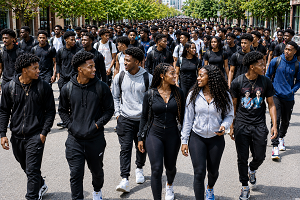
Memorial Day weekend closed out at 57th Street Beach with what Chicago now calls a “teen takeover.” By the time it was over, 53 people had been arrested — including a 14-year-old — and three men were shot in the 1600 block of East 55th Street, a few blocks away. All three survived.
By Tuesday morning, aldermen were already in front of cameras. Public Safety Committee Chairman Brian Hopkins wants earlier curfews. Superintendent Larry Snelling wants accountability. A parent accountability ordinance is being drafted. A social media ordinance is being explored. This is the policy conversation Chicago is having. It is not the right one.
From Washington to Atlanta to Tampa, the same events have produced the same responses: tougher juvenile prosecution, parent accountability laws, curfews, expanded police tools. In Washington, interim U.S. Attorney Jeanine Pirro — the former Fox News host appointed by President Trump in May — announced plans to hold parents legally responsible for their children’s involvement. The Heritage Foundation’s Zack Smith framed teen takeovers as standing in stark contrast to the Trump administration’s progress on crime and pointed the finger at prosecutors who haven’t been aggressive enough with juveniles.
This is the political genealogy of the parent accountability push. It should be named as such. And tested against the evidence. National Guard troops are currently patrolling Washington, D.C. as part of the administration’s crime crackdown. That is also where a large brawl broke out at a Chipotle in the Navy Yard neighborhood. Maximum enforcement, active military presence. The brawl happened anyway. That does not refute a theory. But it exposes the gap between the promise of enforcement-first logic and the stubborn fact that disorder persists even under National Guard presence.
Researchers at the University of Chicago Crime Lab found that targeted summer employment programs reduced violent-crime arrests among vulnerable youth by roughly 43 percent over sixteen months. Violence responds to social investment in ways American political culture is uncomfortable admitting: Youth are essential infrastructure. Not symbolically. Not rhetorically. Literally.
A bridge does not merely “help” a city function. It absorbs pressure that, left unmanaged, disrupts everything connected to it. Youth development systems perform the same role. When those systems weaken, disorder spreads outward.
Chicago’s current struggles did not emerge accidentally. They emerged as the city dismantled many of the institutions that previous generations had relied upon to organize, mentor, and support young people. The 2013 closure of more than fifty public schools — largely in neighborhoods already under stress — weakened civic anchors that also functioned as sources of safety, recreation, mentorship, and community identity. Consider what the South Side once had.
In the late 1960s, musician, educator, and community organizer Phil Cohran transformed 63rd Street Beach into one of the city’s most vibrant public gathering places. His legendary On the Beach concerts brought thousands of people together for music, poetry, dance, food, political discussion, and intergenerational exchange. Gwendolyn Brooks memorialized those gatherings in her poem “The Wall,” describing them as an hour of tribe and of vibration.
The significance of those gatherings was not simply artistic. They represented infrastructure. The same Phil Cohran who helped found the Association for the Advancement of Creative Musicians also built institutions around those gatherings. Through the Afro-Arts Theater, young people studied music, language, health, history, and culture while learning from working artists, educators, and community elders. Future artists, including Chaka Khan, Maurice White, and Kahil El’Zabar passed through that ecosystem. Thousands of young people gathered. At a South Side beach. In public. For hours at a time. The city did not respond by debating curfews. The community responded by building institutions around the gathering.
Young people have not fundamentally changed. What has changed is the infrastructure surrounding them. Park district field houses, church programs, music programs, summer jobs, and libraries once formed an ecosystem of support extending far beyond formal education. None of these institutions eliminated conflict. What they did was absorb pressure before it became crisis.
When infrastructure disappears, disorder becomes visible. Calling that visibility a trend mistakes a symptom for a cause. The parent accountability ordinance now being drafted is a precise example of this substitution.
It proposes a legal mechanism to punish parents — most of whom are working-class, most of whom are Black, many of whom are navigating housing instability and income precarity — when their children engage in conduct the city has not provided adequate alternatives to prevent. This is accountability aimed downward, at the most resource-constrained people in the system, by a city that closed fifty schools in their neighborhoods eleven years ago and has never been held accountable for what that cost.
The parent of a 14-year-old who ended up at 57th Street Beach on Memorial Day did not create the conditions that made that gathering appealing. The city did. Levying a fine or prosecuting that parent does not rebuild what was dismantled. It simply adds another pressure to a family already under pressure.
Accountability without corresponding investment is not a policy. It is punishment theater — and it allows the architects of disinvestment to frame their inaction as someone else’s moral failure.
The social media ordinance follows the same logic: suppress the amplifier without addressing what is being amplified.
Detroit Mayor Mary Sheffield is taking a different approach — working directly with the organizers of takeover events to understand what’s driving them and proposing significant new funding for youth-centered solutions. Atlanta Mayor Andre Dickens has invested in creating “third spaces”: recreational centers, and alcohol-free clubs designed to give young people structured places to gather.
Detroit is proposing $5 million. Chicago’s response is a parent accountability ordinance. The difference is not a matter of philosophy. It is a matter of political will.
One more fact: the Edward Byrne Memorial Justice Assistance Grant program is the leading source of federal justice funding for states and localities — the primary vehicle for exactly the violence prevention and youth development work the evidence supports. The same federal administration promoting the enforcement-first narrative quietly terminated grants initially valued at $820 million from that program. More than 550 organizations across 48 states lost funding. Many were doing precisely the work that keeps young people out of the crowd in the first place.
The administration defunded prevention. Now it is selling punishment. That is not a contradiction. It is a strategy. The problem is not missing evidence. It is that the United States funds youth stabilization as an optional service, not essential infrastructure.
The unresolved question is not what to do about teen takeovers. The answer is already known. The question is whether elected officials are prepared to fund what works — or whether it is easier to pass laws that punish people for living inside a collapse that policy built.
No city debates whether bridges require maintenance. It funds them or accepts collapse.
Floyd Webb is a Chicago-based filmmaker, writer, curator, and founder of the Blacknuss Network. He founded the Black Light Film Festival in 1982 and has spent decades documenting and exhibiting Black independent and diasporic cinema internationally.