
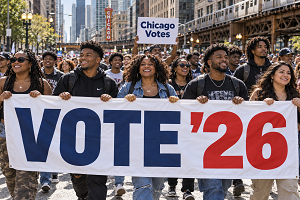
For Chicago Votes, registering a young voter is only the beginning. The goal is to help that person understand the ballot, get to the polls and build a habit of participating in the decisions that shape community life. Under Stevie Vallas, who became executive director in 2017, the nonpartisan nonprofit has made civic engagement accessible to young people through voter education, cultural events and organized trips to the polls. Its work reaches Black, brown and marginalized voters ages 17 to 35, connecting political participation to the issues they encounter every day.
A 2010 graduate of Oakwood University, Vallas brings a youthful voice and political experience to that mission. With the 2026 midterms approaching and Chicago’s 2027 municipal elections ahead, his organization has plenty to do.
“We have a seven-person internal full-time staff and a lot of part-time community organizers,” Vallas explained.
One immediate priority is helping Chicagoans understand the school board election. This November, voters will choose representatives for a fully elected board, including its first elected president. The new board takes office in January 2027, completing the transition from mayoral appointments to elected governance.
Chicago Votes is organizing candidate forums to help residents learn who is running and what each candidate proposes for Chicago Public Schools. The challenge is to make an unfamiliar election understandable to families whose children will be affected by the outcome.
“From our vantage point it’s important to make sure people have access to information about who these school board candidates actually are, so people can make informed decisions,” Vallas said.
“This is a whole new governing body in the city of Chicago, and they have so much power over the most important system to our kids in Chicago. So, it’s a big deal.”
The organization is also preparing for the mayoral and aldermanic contests.
Plans include a voter guide, candidate forums and Parade to the Polls events to help residents become familiar with candidates and their platforms.
“Chicago Votes doesn’t endorse candidates,” Vallas explained. He said its issue advocacy includes asking candidates where they stand on priorities important to the organization and sharing those answers with voters.
Voting rights and investment in young people are central concerns. Policing, police funding and culture also matter to its base. By putting those questions before candidates, Chicago Votes seeks to connect campaign promises with
the concerns young residents bring to the political process.“Youth investment is really important to us,” Vallas said.
Meeting those ambitions will require more staff and financial support.
Vallas said the organization needs to roughly double its size to comfortably carry out the work it wants to accomplish. “We’re always actively fundraising and we’re doing pretty good,” he said. Current support helps sustain operations, but the organization needs additional funding to expand. It plans to pursue fundraising opportunities at
the end of the year while continuing its election work.
Chicago Votes also works alongside a broad network of civic and advocacy organizations. Vallas named CHANGE Illinois, PUSH, the League of Black Women, the Chicago Lawyers’ Committee for Civil Rights, Common Cause Illinois and the Black Voter Project, among others.
Other partners include the Illinois Coalition for Immigrant and Refugee Rights, She Votes Illinois, the Illinois Alliance for Reentry and Justice and
the Illinois Coalition to End Permanent Punishments. Those relationships connect its youth engagement work with wider efforts around voting access,civil rights and the legal system.
For the midterms, Vallas emphasizes both registration and turnout. Knowing the candidates matters, too. Illinois voters will select a successor to retiring U.S. Sen. Dick Durbin, with Democrat Juliana Stratton and Republican Don Tracy among the candidates seeking the seat.
“We want to make sure everyone is registered,” Vallas said. “But registration is not enough, we’ve got to get everyone to the polls.”
That conviction drives Parade to the Polls, one of Chicago Votes’ oldest initiatives.
The program brings young people to vote from high schools, colleges, concerts and community events, turning an individual civic duty into a shared experience.
Its mission is to establish a tradition of voting through local civic action.
Rather than assume first-time voters will navigate the process alone,organizers coordinate celebratory trips that help make voting feel familiar, welcoming and achievable.
The initiative has engaged more than 20 high schools and brought more than 5,000 young people to cast their first ballots, according to the organization.
Its approach includes high school, college and community parades, each designed around the people it serves.
For high school students, the emphasis is on a safe, comfortable and enjoyable first voting experience. Going with classmates and organizers gives young voters support as they take part in an election for the first time.
On college campuses, the parades bring student organizations together around issues affecting students and their communities. Participants gather at a central campus location, rally and head to the nearest early voting site.
The citywide effort began in 2016, when Chicago Votes partnered with local artists for a free get-out-the-vote concert in Millennium Park. A second citywide event followed in partnership with Women’s March Chicago.
Both drew thousands of Chicagoans and encouraged early voting through large, coordinated marches to the polls.
For young people, those gatherings offer an entry into politics through places and activities they already know. Music, campus life and neighborhood events become opportunities to learn about an election and participate with others. The approach gives civic engagement a place in community life, rather than leaving it as an occasional reminder to register.
It also keeps the focus on participation: learning what is at stake, asking questions and making an informed decision when it is time to vote.
The celebration is backed by practical information. Ahead of elections,Chicago Votes produces nonpartisan voter guides with dates, deadlines, explanations of the offices on the ballot and candidate questionnaires.
The aim is to help residents arrive prepared to make their own choices.
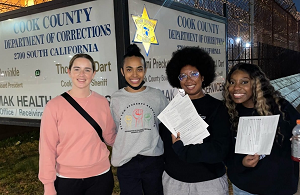
Another significant part of its work reaches people inside Cook County Jail.
In fall 2017, Chicago Votes was asked to become the official sponsor of election activities there, extending voter education and access to people often left out of civic outreach.
That work developed into Unlock Civics, which encompasses its Civics in Prison and Voting in Prison legislative efforts. The initiative seeks to ensure that people affected by the legal system understand their civic rights and responsibilities. Voting in prison remains an advocacy goal, distinct from voting access for eligible people held in jail.
According to Chicago Votes, its work in Cook County Jail has inspired organizations and jails elsewhere in the country to adopt its approach.
The initiative reflects a broader commitment to helping people participate even when institutions or circumstances have placed barriers in their path.
Across these programs, the message is consistent: people need information, access and encouragement to exercise their voting rights. A candidate forum can clarify a choice. A voter guide can explain an unfamiliar office. A parade can help a first-time voter take that final step into a polling place.
For Vallas and Chicago Votes, the work continues beyond any single election. Each informed ballot and each returning voter helps build the lasting civic participation the organization is working to make part of Chicago’s everyday culture.