

A reflection on patriarchy, production modes, and the unfinished work of equity.
Think about the last time someone justified rigid gender roles—or dismissed the idea of reparations—by saying, “That’s just the way things are.” There’s a quiet assumption buried in that phrase: that our current social arrangements are natural, inevitable, maybe even divinely ordained. But what if they’re not? What if the rules we live by were simply built to fit a world that no longer exists?
That’s the question worth sitting with this Father’s Day—not just as a celebration of the fathers in our lives, but as an invitation to examine the deeper forces that have shaped what “fatherhood,” family, and community even mean in America today.
We Didn’t Always Live This Way
For most of human history, the vast majority of our time on this planet, we were nomadic hunter-gatherers and our tribal lives were inscribed by the ethics of the era. And the social ethics of any era, it turns out, are rarely about morality in the abstract. They’re about survival. They grow out of how a community produces and shares its resources.
In early hunter-gatherer societies, men’s upper-body strength made them effective hunters, so social structures naturally tilted toward male authority. But “gatherers”—largely women—were just as essential to survival. And in many of those early societies, that contribution earned women genuine status: historical records show female leaders, matrilineal family lines, even goddess worship. Gender equality, it turns out, is not some radical modern invention. In some corners of human history, it was simply common sense.
How Farming Gave Us Patriarchy—and the God to Bless It
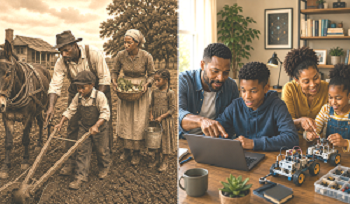
Everything shifted when humanity moved into large-scale agriculture. Suddenly, physical strength—the ability to drive plows, haul earth, and wield heavy tools—became the engine of economic survival. Masculine muscle wasn’t just useful or ornamental; it was the currency of the community.
It was no coincidence that the world’s major religions took shape during this same era, roughly eight hundred–200 BCE—a period historians call the Axial Age. Born into a world where agrarian labor was king, these faiths absorbed the gender hierarchies around them and gave them a sacred seal of approval. God was male. Roles were fixed. The family structure was considered a reflection of the cosmic order.
We can see that same impulse at work today. When political movements reach for a “return to tradition,” they’re often reaching back to an agrarian social order—one built around physical labor, strict gender roles, and racial hierarchy—and wrapping it in the language of faith and nationhood.
The World Has Changed. The Rules Haven’t Caught Up.
Here’s the thing: we don’t live in an agrarian economy anymore. The skills that once determined survival—raw physical strength, masculine endurance—are increasingly beside the point.
In a knowledge economy, and even more so in the AI-driven era emerging around us, the premium is on adaptability, creativity, and emotional intelligence.
Some futurists suggest that in the coming decades, physical strength may become almost entirely vestigial as a marker of economic value. If that’s true, then the patriarchal ethic it underpinned—the idea that dominance and masculinity are naturally linked—faces a genuine reckoning.
But changing the economy doesn’t automatically change the culture. And for Black Americans, there’s a particular burden that no technological revolution alone will lift.
A Wound That Compound Interest Can’t Ignore
Father’s Day, in Black America, carries a particular weight. For generations, Black men have been systematically denied the ability to fully function as heads of household—not because of personal failure, but because of deliberate, structural exclusion from education, economic opportunity, and civic life. That exclusion wasn’t accidental. It was policy.
And when you’re locked out of economic and cultural capital—the networks, the institutions, the generational wealth that quietly lubricates upward mobility for others—the damage doesn’t stay in one generation. It compounds.
This is why reparations aren’t a “hand-out.” The framing is worth pushing back on. The white American middle class didn’t build itself on bootstrap individualism—it was constructed through massive and targeted government intervention: the New Deal, the GI Bill, federally backed mortgages, public university systems. These programs worked. They built a middle class. They just didn’t build it for everyone.
There’s also what might be called a “John Henry Syndrome” at work in our community—a fierce, understandable pride that sometimes pushes us to overstate our resilience even as the resource gap widens. John Henry drove steel faster than the machine and still died proving it. Pride is not the same as power.
So, What Do We Do With This?
This Father’s Day, it’s worth holding two things at once: gratitude for the fathers and father figures who showed up—often against serious odds—and clear-eyed honesty about the structural forces that made their job harder than it needed to be.
The technological transformation coming won’t automatically dismantle racial hierarchy—history suggests it rarely works that way without deliberate intervention. Closing the gap requires what it has always required: targeted investment in education, economic inclusion, and community infrastructure. Not charity. Repair.
The social rules we inherited were built for a world of plows and muscle and enforced hierarchy. We are building a different world now. The question is whether we’ll be intentional enough to build it for everyone this time.