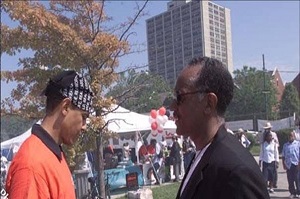


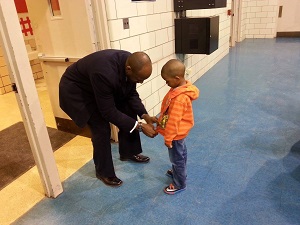
For Michael Neal, service was never about a title.
Long before he became a pastor or community leader, Neal was simply responding to a calling that had been shaped by his upbringing on Chicago’s South Side.
Raised in Park Manor near 67th and Wabash, he remembers a neighborhood defined by connection, accountability, and care. “We were so close-knit as children, I assumed everybody on the block was related to me,” Neal recalled. It was the kind of community where neighbors looked after one another, where adults watched over every child as if they were their own, and where the sense of collective responsibility was deeply understood. That early experience of community would later become the foundation of Neal’s life’s work.
“I didn’t think of it as leadership,” he said. “I thought of it as being a servant.”
Today, Neal serves as pastor of Glorious Light Church and continues to lead the Timothy Community Corporation (TCC), a South Side-based organization focused on literacy, health, and leadership development. Through mentorship initiatives, wellness programming, and educational outreach, the organization has spent more than a decade investing directly into the community.
And while the organization is currently navigating one of its most significant transitions to date, Neal remains grounded in the mission that first inspired its work.
Building What the Community Needed
Founded in 2012, the Timothy Community Corporation was created with a simple but powerful belief: everything needed to strengthen the community already exists within it.
The organization’s name is drawn from scripture, specifically 2 Timothy 2:2, which emphasizes passing knowledge and wisdom to others. “It reminds us that we already have the skills and talent,” Neal said. “It’s now on us to share them.” That philosophy has shaped every program the TCC has launched.
One of its earliest initiatives, South Side Fit, was developed in response to alarming health disparities across the South Side. After hearing data presented by leaders from the University of Chicago about disproportionately high rates of asthma and other health concerns, Neal felt compelled to act. The result was a free fitness initiative designed to eliminate financial barriers to health and wellness while creating measurable pathways toward better health outcomes.
“If the South Side was being described as sick, we wanted to envision it as fit,” Neal said. The organization’s literacy work grew from a similar sense of urgency.
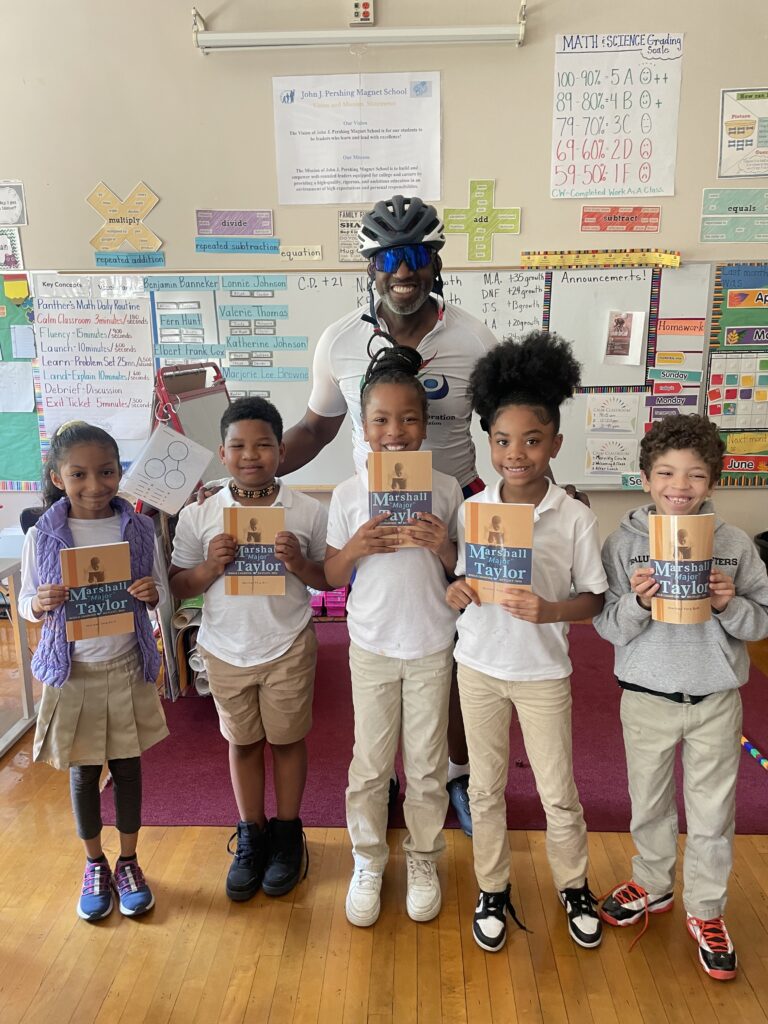
While operating Glorious Light Church, Neal began volunteering to read to students at local schools. What began as a simple act of service soon evolved into something much larger after he witnessed firsthand the lack of Black male representation in educational spaces.
That realization sparked what would become Leading With Literacy, a program that brings Black men into schools to read to children during their most formative years. “My goal has always been pre-K through third grade,” Neal said. “Those are foundational years.”
Over time, the impact became undeniable. Neal recalls moments when former students—some now in college—have approached him in stores or community spaces to remind him that he once read to them as children.
“It’s like a slow cooker,” he said. “Sometimes you don’t immediately see the results, but eventually you do.”
A Difficult Transition
For years, much of this work operated out of a former Chicago Public Schools building on 43rd & Drexel, a space that became a hub for programming, outreach, and community connection. The building represented more than a location—it was the physical manifestation of a vision Neal first imagined years earlier after visiting a thriving community center in Memphis.
“When we saw what was possible there, I remember saying, ‘This would be incredible for Chicago,’” he said. When the TCC was later given the opportunity to operate from the Drexel building, it felt as though that vision was becoming reality. That made the recent decision requiring the organization to vacate especially painful. “It was a gut punch,” Neal said.
The transition came suddenly, leaving the organization with only weeks to relocate. Still, even amid uncertainty, Neal remained focused on continuity rather than defeat. “That’s part of leadership,” he said. “Even during difficult times, you stay centered on the mission. And the mission has not changed.”
The TCC has since relocated to Holy Angels Catholic School, where programming continues as the organization adapts to its new environment. For Neal, the move represents both challenge and opportunity.
Because Holy Angels is an active school, the new location offers direct access to students and families while opening new possibilities for engagement. “It gives us another chance to make an even bigger impact,” he said.
Leading Into the Future
That same commitment to education and community advocacy continues to shape Neal’s work across the South Side. For him, investing in schools and young people is not separate from community leadership, but one of its most essential expressions.
Though the path forward continues to evolve, Neal remains focused on expanding opportunities for students and families across the South Side.
After reflection, however, he realized it was simply an extension of work he had already been doing for years. Through literacy programming alone, the TCC has distributed more than 50,000 books to students. “This is what I’ve already been called to do,” Neal said.
He believes stronger collaboration between schools, families, and community organizations is essential to creating environments where students can thrive.
For Neal, schools are far more than educational institutions—they are pillars of neighborhood life.
“The most important building in the community is the school,” he said. It is a belief that reflects not only his work but his understanding of fatherhood, mentorship, and leadership itself.
He sees all three as rooted in responsibility, presence, and encouragement. “I want young people to know their voice is powerful,” Neal said. That message remains central to everything he does. Though the building may have changed, the work continues.
And for Michael Neal, the mission remains exactly where it has always been: with the people of Chicago’s South Side.