


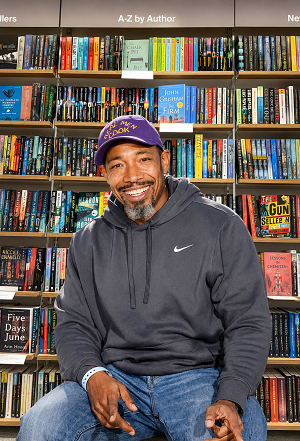
The greatest gift you can give your child isn’t a toy, a gadget, or even a college fund — it’s a lifelong love of reading.
Father’s Day is here — and if you’re a dad, you’ve got every reason to stand tall. Whether you’re raising a toddler or a teenager, whether your house is full of boys, girls, or the beautiful mix of both, this season is yours. You look forward to that handmade card, that favorite restaurant, that cologne you’d never buy yourself. You’ve heard speeches about what it means to show up for your kids, and you’ve taken them to heart. You want to hand your child the world.
Well, here’s the thing: you can. Not on a silver platter — between two covers. A book. Or better yet, a love of books. A love of reading. That might just be the greatest gift any parent can give. And yes — this is for the moms, too. Dad gets the headline this month, but every word that follows applies equally to the woman who holds the other half of this family together.
The Gift of Self-Esteem
You’ve probably dreamed of building generational wealth for your children — something that will anchor their futures long after you’re gone. But consider this: helping your child fall in love with reading may be worth far, far more. There’s no sugarcoating it — this country is still deeply segregated. And that segregation takes a toll on the self-esteem of children. In 1940, psychologists Dr. Kenneth and Mamie Clark conducted what became known as the “Doll Test.” They placed four identical dolls — two Black, two white — in front of Black children between the ages of three and seven. The majority of those children pointed to the white doll as the pretty one, the smart one, the good one. The Black doll, they said, was ugly. Bad.
That was 1940. But the wounds run deep and long. The good news? The antidote is right there on the bookshelf. Today, there are hundreds of books by Black authors written for children of every age — stories with heroes who look like them, struggle like them, and triumph like them.
Books that say: you are seen, you are valued, you matter. That kind of representation doesn’t just feel good. It builds identity.
The Gift of a Sharper Mind
Reading improves memory. It builds critical thinking skills. It expands vocabulary in the most organic way possible — through story, through context, through imagination. When a child reads, they don’t just absorb words on a page; they construct entire worlds in their minds. That visual thinking — picturing scenes, characters, settings — is a cognitive workout that no app can replicate.
In an era of social media, where messages get squeezed into 140 characters, and words get swapped for abbreviations, literacy is eroding quietly. It’s jarring to read a college student write “Ahm fitn to go 2ma” in place of a complete sentence. It shouldn’t be shocking — but it is because it tells us something has been lost. Reading is how we get it back.
The Gift of a Wider World
When a child reads, they don’t just absorb words; they construct entire worlds. Books make children into travelers — not just of places, but of time, culture, and possibility. Through stories, a child who has never left their neighborhood can walk the streets of Lagos, sail with ancient Malian explorers, or stand in a Parisian trench alongside the brave Black soldiers of World War I who came home as heroes in France even as they were denied that honor at home.
Some children grow up believing Africa is a monolith of poverty or wildness. Books dismantle that. They reveal Africa as the cradle of civilization — the largest, most diverse continent on Earth, the origin point of humanity itself. They teach children that Black inventors gave the world the filament that makes electric lights glow, the touch-tone phone, call forwarding, call waiting, and the fax machine. That’s not trivia. That’s a birthright. And when children read it, they carry it — head high.
The internet is remarkable. The smartphone is powerful. But neither of them is a substitute for a library card.
For too many children today, the phone has replaced the book — and it doesn’t have to be that way. Start early. Start with picture books. Read aloud until they can read on their own, and then keep reading together anyway. Let them pick the stories. Let the Black Panther be their superhero. Let comic books count. Find the series that makes them lose track of time and then get out of the way.
Once upon a time, book reports were mandatory, and there were no shortcuts — no Cliff Notes, no AI summaries. Children actually had to read the book. That accountability helped. So did curiosity. Both can be cultivated.
The gift of reading doesn’t expire. It doesn’t get donated to Goodwill or outgrown by summer. It goes everywhere your child goes — into every classroom, every job interview, every quiet moment of their life. Hand them that, and you’ve handed them everything.
After Notes
According to the National Assessment of Educational Progress, only about 17% of Black 4th graders score at or above the proficient level in reading. An intentional short-form daily reading approach is recommended to help shift these statistics in several ways.
It mitigates the “Million Word Gap” at home.
Due to historical, systemic inequities in book access, children from marginalized communities are frequently exposed to fewer written words before entering kindergarten.
Reading aloud for just 7 minutes a day introduces children to roughly 290,000 more words by age 5 than those who do not read regularly. This foundational vocabulary makes learning to read easier.
It Lowers the Barrier to Entry Against “Time Poverty”: Many Black parents work multiple jobs or lack access to childcare, making 30 – 60-minute reading block unrealistic.
A 7-minute stand is achievable and allows exhausted parents to build a consistent habit without triggering the “reading as a chore” mental barrier. Consistency successfully trains the brain.
It Reclaims Literacy as Empowerment and Culture: Standardized school curricula often rely on Eurocentric texts that do not reflect lived experiences of Black children, causing them to disengage from reading. 7 minutes of daily choice-based reading allows Black youth to engage with culturally affirming literature.
It overcomes the Stress Barriers to Learning. Chronic stress impairs a child’s brain’s memory and hinders their ability to focus or comprehend.
6 to 7 minutes of reading is proven to lower cortisol levels, placing the student’s brain into a receptive state optimized for learning and information retention.