


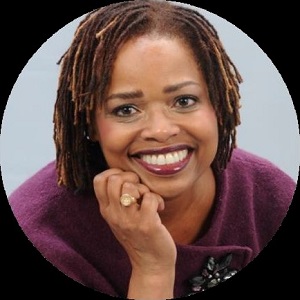
Chatham gave Nedra Sims Fears what she calls an ideal childhood — safe, joyful, and filled with excellent teachers who prepared her for success. Today, she is paying that gift forward as Executive Director of the Greater Chatham Initiative (GCI), bringing her dedication, creativity, and expertise back home.
Fears is an economic development specialist with deep experience in strategic planning, financial modeling, community development financing, and program management. But above all, she is a daughter of Chatham.
“Seventy percent of Black people live in all-Black neighborhoods,” Fears said. “We need to take care of Black neighborhoods because that’s where the majority of Black people live.”
When Congressman Bobby Rush, Mayor Rahm Emanuel, and other leaders championed the creation of an organization to support and strengthen Chatham, Fears answered the call.
Rising to the occasion, however, came with challenges. One of her first tasks was simply getting the organization off the ground.
“I was literally running the Greater Chatham Initiative out of my checking account until we were able to get it up and running,” she recalled.
Establishing credibility, securing funding, and building staff were essential early steps. Residents welcomed the organization because it filled a long-standing need.
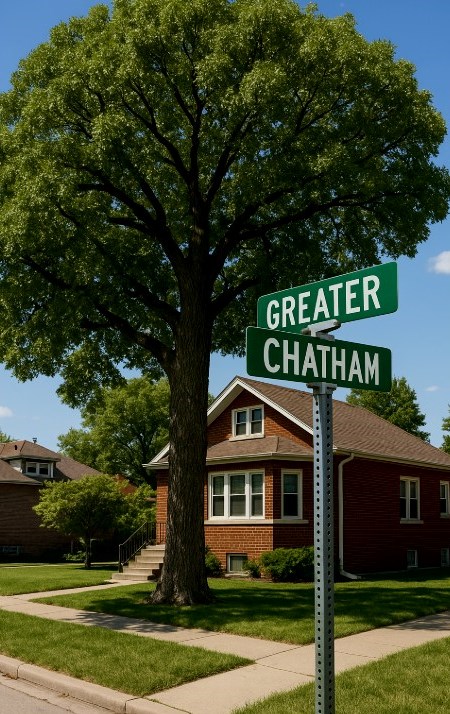
Greater Chatham includes four neighborhoods — Chatham, Greater Grand Crossing, Avalon Park, and Auburn Gresham — communities Fears describes as vibrant but often overlooked.
“No one has really championed them,” she said. “We have to go out and market ourselves against what I call ‘the parks.’”
By “the parks,” she means neighborhoods like Hyde Park, Lincoln Park, and Humboldt Park — places that often dominate Chicago’s public image. Fears believes Greater Chatham deserves equal recognition.
“Our communities have beautiful, affordable housing stock,” she said. “We have great schools, good shopping, strong transportation, and a wonderful restaurant district with Soul, Caribbean, and West African food. We have festivals every year.
It’s a great place to live and work.”
A middle working-class area with a long history as a mixed-income community, Greater Chatham saw a new surge of homebuyers during the Covid pandemic.
Fears explained that first-time homebuyer programs, supported by grants such as one from Wells Fargo through Neighborhood Housing Services, helped residents track opportunities in the area.
“When Covid hit, people wanted out of small apartments,” she said. “They wanted a house.”
For many, buying in neighborhoods like Hyde Park was financially impossible, where Greystones can cost one to three million dollars. But in Chatham, families could afford a bungalow with a far smaller down payment.
“So, what we saw was people living elsewhere for the lifestyle,” Fears said, “but when they decided to purchase a home, they purchased in Chatham.”
Fears describes Greater Chatham as a tale of two communities: renters along major corridors like 79th and 87th Streets, and homeowners, including a fast-growing population earning six figures.
Millennials in particular are drawn to two-to-four-unit buildings, often using “house hacking,” where rental income helps cover mortgage costs.
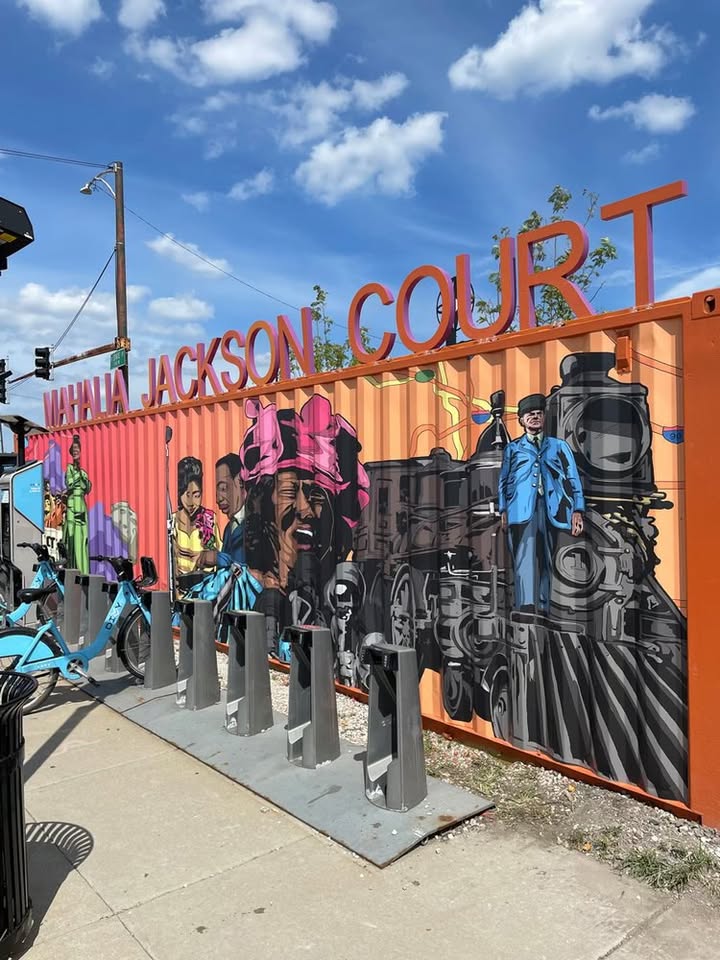
Among Greater Chatham’s most celebrated achievements is the transformation of the Mahalia Mile into a cultural district.
“That goes back to place-making,” Fears said. “Residents are proud of their legacy notables.”
Those notables include gospel legend Mahalia Jackson, music pioneer Thomas Dorsey, Johnson Products founder George Johnson, Earth, Wind & Fire, Ernie Banks, jazz great Von Freeman, Chance the Rapper, Lena Waithe, and Poet Laureate Gwendolyn Brooks.
“We’ve had this oral history,” Fears said, “and none of it was documented.” Now, eleven murals throughout Greater Chatham preserve that heritage, complete with QR codes linking viewers to videos and stories, including one called Three Senators, featuring Barack Obama, Carol Moseley Braun, and Roland Burris.
The initiative also offers trolley tours in the summer, virtual tours year-round through Mahaliasmile.com, and architectural tours highlighting Chatham’s historic districts and distinctive mid-century housing.
Progress across Greater Chatham has been substantial. Housing values have risen, allowing long-neglected properties to finally be rehabilitated.
Residents can also look forward to infrastructure improvements aimed at preventing basement flooding. GCI is disconnecting downspouts, planting trees, and installing rain gardens at no cost to homeowners. Nearly 500 trees have already been planted, with 400 more planned.
Beyond housing, GCI has become a vital partner for local businesses. Over the last nine months alone, the organization has helped businesses secure $10 million in grants and loans.
Soul Veg received assistance in purchasing the space it had rented for more than two decades. Brown Sugar Bakery also benefited through financing support.
This summer, GCI will unveil its Black Culinary and Heritage Tour, spotlighting 24 restaurants representing barbecue, soul food, Caribbean, and West African cuisine across Greater Chatham.
Five years ago, one resident challenged Fears directly:
“You’ve got to give me a reason to stay here and not go to Hyde Park, Beverly, or downtown.”
From the looks of Greater Chatham today, Nedra Fears and the Greater Chatham Initiative are giving residents not just one reason — but many. And they’re staying.