

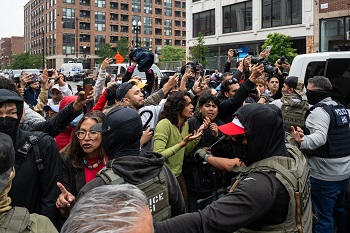
Today, as we see ICE (Immigration and Customs Enforcement) in our communities, we are seeing a new reality, a racialized pattern of policing and deportation that often goes unacknowledged. ICE is not only policing, detaining and deporting undocumented immigrants from various communities, but Black immigrants and even African American citizens are at a greater risk of being apprehended, detained, separated from their families, and even deported to countries they have never lived in.
ICE comes to Black communities because they obviously think Black immigrants are more likely to settle in predominantly Black areas such as South Shore and Bronzeville. These victims are seldom discussed in the media or social media, yet they face higher rates of detention and deportation than non-Black immigrants, even though fewer of these immigrants are undocumented. We’ve heard the expression, “they (Black people) all look alike.” This is sadly true and as recently seen, ICE does not distinguish natural-born African American citizens from Black immigrants. That reality came true for the residents of an apartment building in the South Shore Community. One African American citizen reported that federal agents broke into his apartment and tied him up with zip ties. Others reported that children were zip tied and brought out naked, and that African Americans and immigrants were put into separate vans.
South Shore, Bronzeville, Auburn Gresham, Englewood and other Black Chicago communities have been over-policed for decades. Thus, anti-Black racism intersects with anti-immigrant sentiment to put Black Chicagoans at risk from ICE. Racial bias also taints the police data, including arrest records and controversial gang databases, which ICE relies on. Therefore, US-born Black residents find themselves in the immigration enforcement systems, and Black immigrants with minor criminal records are often marked as “public safety threats” even when those records are outdated or nonviolent.
Now more than ever, we must keep hope alive in our communities, such as Bronzeville, long known as the “Black Metropolis,” once a hub of Black excellence in business, music, and art. For communities such as South Shore, with its rich lakefront history, once a thriving community, it is now coming back with businesses such as The Quarry, Sisters in Cinema, Give Me Some Sugah, Sarah’s Café, Manjanis and so many more.
Many of our communities are already burdened by underfunded services and economic inequality, and now ICE raids, making it harder for residents to feel safe or seek help.
And still, we rise! Despite these challenges, South Side residents have not remained silent. Black residents have joined with other communities to demand more inclusive sanctuary policies, while also challenging data-sharing practices between local police and ICE, developing grassroot efforts to push back against both racial profiling and immigration enforcement.
Black churches are stepping into immigration defense roles. Reverend Otis Moss III of Trinity United Church of Christ, and Father Michael Pfleger of St. Sabina Church have made strong statements, jointly and individually, bringing hope to our communities and not only talking the talk, but literally walking the walk. These churches and others offer sanctuary, legal assistance and safe spaces for organizing. Youth-led groups are also at the forefront, connecting issues like housing, injustice, police violence, and immigration enforcement to build a more comprehensive vision of community safety.
The Black community faced similar challenges throughout our history –we survived Jim Crow, redlining, police brutality, white on Black violence. Black school closings – and through prayer, unity and resistance, this too shall pass.