

A discussion about Chicago often concentrates on what is wrong with the city. The financial pressures are real. Housing remains too expensive for many families; public transportation needs improvement, and some neighborhoods still endure far more violence than others. But that is not the whole Chicago story. Over the past two years, the city has also recorded substantial progress in youth employment, public safety, workers rights, mental-health care, affordable housing and tourism.
Those gains deserve to be recognized, not as political advertising and not as proof that every problem has been solved, but as evidence that Chicago is capable of moving in a better direction. Mayor Brandon Johnson cannot claim sole credit for every favorable trend. Still, his administration can point to several policies and investments that have helped strengthen the city and expand opportunity for working families.
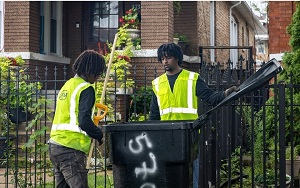
One of Johnson’s clearest accomplishments is the expansion of Chicagos summer youth employment program. In 2025, the city connected 31,119 young people between the ages of 14 and 24 with paid summer jobs. Like the Department of Streets and Sanitation. Last year one hundred and twenty youth went on to become full-time DSS employees, with salaries of as much as $90,000 annually.
The young participants completed 2.84 million hours of work experience and project-based learning and collectively earned more than $30.9 million in wages. Those dollars did more than provide spending money. They helped young people contribute to their households, learn workplace expectations, build confidence and begin developing professional networks. The program, formerly known as One Summer Chicago, has been renamed Chicago Youth Works, with the straightforward message: “Get Paid. Get Skilled. Get Ahead.”
Youth employment is also part of a larger public-safety strategy. A summer job by itself cannot eliminate violence, but paid work, adult mentorship and a safe place to spend the day can give young people alternatives and a stronger connection to their communities.
Chicago experienced a historic reduction in violent crime during 2025. The city recorded approximately 416 homicides, compared with 587 in 2024 – a decline of about 29 percent and the lowest annual total since 1965. Shooting incidents fell from 2,274 in 2024 to 1,471 in 2025. The improvement continued into 2026: during the first half of the year, robbery declined 28 percent, carjacking 27 percent and residential burglary 13 percent compared with the same period in 2025.
Violent crime fell in many American cities, and researchers continue to debate the reasons. Chicago, however, has invested in several approaches at the same time: traditional policing, increased investigative capacity, youth employment, mental-health response and community violence intervention.
Johnson’s administration says it exceeded its goal of adding 200 detectives and reorganized the Chicago Police Department’s detective bureau so that more resources could be devoted to investigating and solving crimes. The broader effort to civilianize appropriate administrative positions is intended to keep trained officers from being used for desk assignments that do not require police powers, making more sworn personnel available for public safety work.
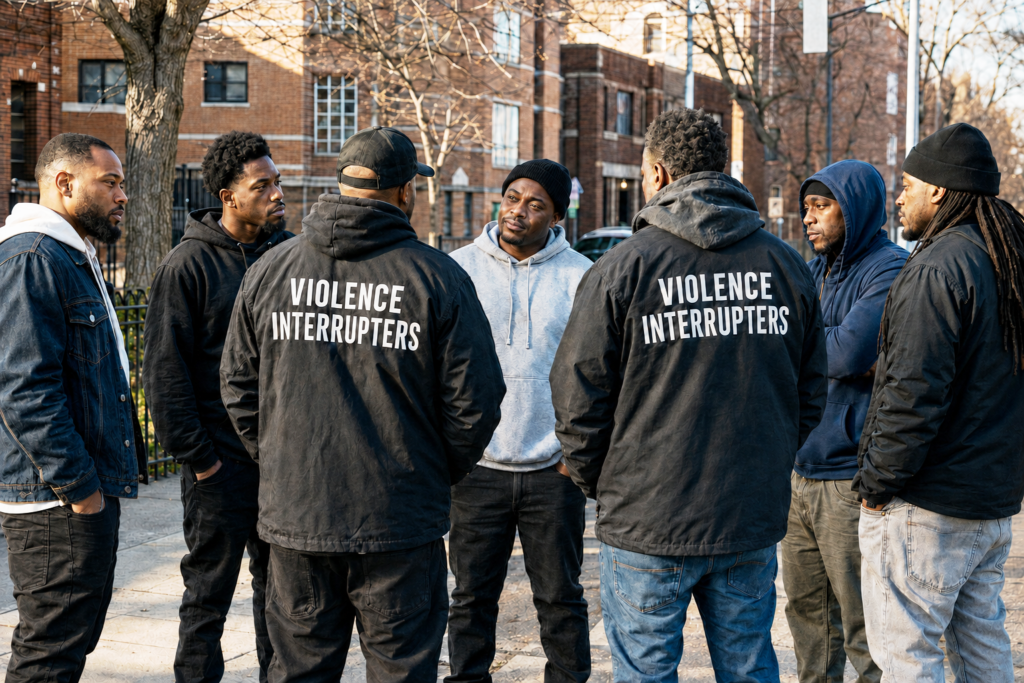
Chicago has continued investing in violence interrupters and street-outreach organizations. These workers often have credibility in neighborhoods most affected by shootings and can intervene in disputes before they become deadly. A Northwestern University study of the largely state-funded Peacekeepers program found that shooting victimizations declined 41 percent in the specific violence hotspots where peacekeepers were deployed between 2023 and 2024. The findings do not prove that community intervention explains Chicago’s entire crime decline, but they offer credible evidence that it can be one part of the solution.
This more comprehensive approach matters. Public safety is not only the arrest made after a shooting. It is also the detective who solves a case, the outreach worker who prevents retaliation, the counselor who answers a crisis call, and the summer employer who gives a teenager a first opportunity.
Chicago has begun rebuilding parts of its public mental-health system after years of clinic closures. Johnson’s Treatment Not Trauma initiative restored or expanded city-operated services at three locations on the West, Southwest and South sides, including Roseland. The city has also expanded the use of mental-health professionals in responding to some crisis calls. Police officers and firefighters will always have essential responsibilities, but not every person experiencing a behavioral-health crisis needs an armed response.
Housing has been another major focus. Johnson secured approval of a five-year, $1.25 billion housing and economic-development bond designed to support affordable housing, commercial corridors and neighborhood investment. Chicago also adopted Green Social Housing, a city-backed financing model intended to create permanently affordable, mixed-income and environmentally sustainable housing.
In 2026, the city announced more than $300 million in support for 15 housing developments expected to create or preserve 1,223 rental homes, including 1,164 affordable units. The projects reach communities such as South Shore, Chatham, Calumet Heights, West Englewood, Woodlawn, Washington Park and North Lawndale. Many of those units are funded or planned rather than completed, so the final results must still be measured. Nevertheless, directing investment toward communities that have endured decades of disinvestment is an important change in priorities.
Chicago’s economy has received encouraging news as well. The city welcomed 56.8 million visitors in 2025, generating a record $21.5 billion in visitor spending and supporting more than 135,000 local jobs. O’Hare International Airport reclaimed its position as the nation’s busiest airport by flight operations and began construction on its first major new concourse since 1993.
The Johnson administration also helped move the long-awaited Red Line Extension closer to construction by advancing the project’s major design-build contract. The planned 5.6-mile extension from 95th Street to 130th Street would serve Far South Side communities that have waited generations for equitable rapid-transit access.
Chicago is better today in several measurable ways. Tens of thousands of young people have received jobs and early work experience. Fewer families are losing loved ones to shootings and homicide. Robberies and carjackings have declined. Workers have stronger rights to paid leave and fairer wages. Public mental-health care is being rebuilt. Affordable-housing investments are reaching neighborhoods that have too often been overlooked. Tourism is setting records, and major airport and transit projects are moving forward.
These accomplishments do not erase Chicago’s remaining challenges. Yet, public safety gains reflect national decline in violence, and several infrastructure projects were inherited from earlier administrations.
But fairness requires acknowledging progress as clearly as we acknowledge problems. Brandon Johnson’s most defensible accomplishments are not slogans. They are the 31,119 young people who went to work, the sharp reduction in shootings and homicides, the expansion of detectives and community-based intervention, the reopening of mental-health services, stronger protections for workers and new resources committed to housing and neighborhood development. Chicago is not finished. It is, however, moving forward – and that progress gives the city something important on which to build.