

At seven, Franklin Hughes saw trash on neighborhood streets and wondered why
people weren’t working together to clean it up. His answer was simple: a community could look the way its residents wanted if they joined forces.
Now 19, the college student and youth organizer brings that same belief to civic engagement, helping young Chicagoans recognize their power—and use it at the polls.
“I believe, historically, decisions have been made about youth where the spaces are too secluded and youth are excluded,” Hughes says. “So, it demotivates youth from wanting to be engaged.”
For him, encouraging young people to vote begins with giving them a role in decisions that affect their lives. Through a coalition he identifies as the Youth Empowerment Space, he works to create places where young Chicagoans can participate and be heard.
The challenge, he says, is a deep distrust of government.
“For generations, long before the city operated out of a fiscal deficit of millions of dollars, it operated out of a tremendous deficit of trust with its residents,” he says. Some young people conclude that their voices don’t matter or that voting is a scam.
Hughes challenges that thinking directly: “I tell them, if it is a scam, certain people
wouldn’t be fighting so hard to take their vote away.”
He also sees misinformation and divisive political labels as barriers to participation.
Civic education, he believes, can help young people question what they hear and make informed choices.
“When I think of mass media corruption, I think of people walking around with their heads down, with a dim light bulb,” he says. “But when a person becomes civically engaged, that light bulb comes on and it’s bright!”
Hughes puts that belief into practice through the Legler Youth Action Table, which he established at Legler Library on Chicago’s West Side. Its first event was a youth media storytelling project documenting what participants loved about their community, what it needed and what they wanted to see amplified.
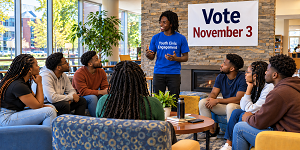
The library setting fits his emphasis on reading and learning about Black history,accomplishments and possibilities.
He also advocates for youth advisory councils that give young people a platform to shape their communities.
“When youth have a platform, they’re more likely to be engaged,” he says. “They need to feel like they have a voice and that they are heard.”
With the midterm elections approaching, voter registration and education are central to the group’s work. Hughes says its collaboration with Chicago Votes has helpe register more than 100 young people.
“Chicago Votes is our hero,” he says.
But registration is only the beginning. The group is developing a voting guide and encouraging young people to share what they learn with friends. Hughes says they are also working with Chicago Votes on a parade to the polls and with organizations that teach civic education.
“If we’re not politically educated, it’s difficult to be politically involved,” he says.
His work extends to the city’s Youth Civic Engagement Committee, where he says young people advise the Office of Education and Youth Services and develop recommendations for Chicago. Hughes says he proposed the name Chicago Youth Works for the youth employment initiative previously known as One Summer Chicago.
He credits Mayor Brandon Johnson with expanding opportunities for youth participation, including the Mayor’s Youth Commission and opportunities to engage through police district advisory councils.
Across these efforts, Hughes’s goal remains the same: help young people gain access to the places where decisions are made and recognize that they have a say.
“My goal for you is to have power, and to be in spaces where power is accessible and you have a say and you have a voice and we’re working together.”