

From the November midterms to Chicago’s 2027 municipal election, rebuilding political power begins face to face.
Here in Chicago, the people doing the real organizing work know what it takes.
Chicago Votes concentrates on young people, students, creatives, residents of disenfranchised neighborhoods and people who are currently or formerly incarcerated. Its Unlock Civics initiative
began as a monthly voter-registration drive inside the Cook County Jail and expanded into civic education, election coordination and legislative advocacy. As of 2026, Chicago Votes has registered more than 11,000 new voters inside Cook County Jail since September 2017. Its work helped make Cook County Jail the first jail in the country to operate an in-person polling place. That is organization. It begins with people whom the political system has attempted to render invisible and tells them that citizenship has not been taken from them.
Rainbow PUSH Coalition has maintained Chicago’s historic connection between civil rights and voting rights. This summer, it provided free training for people seeking to become voter registrars. CHANGE Illinois is recruiting volunteers to help people register, locate polling places and answer voting questions. Through its 2026 Democracy Project, the Illinois Coalition for Immigrant and Refugee Rights places fellows with immigrant-serving organizations across Chicagoland to conduct nonpartisan voter engagement. The League of Women Voters of Chicago and the ACLU of Illinois continue providing voter education, voting-access information and election-protection resources.
On Chicago’s Southeast Side, Southside Together has organized residents around Quantum Shore, the quantum-computing campus under development at the former U.S. Steel site. Its
organizing has brought people into meetings and raised concerns about housing, utilities, remediation, public subsidies and environmental effects. A data center is not currently part of
the quantum campus, although the site’s developer could pursue separate data-center development there in the future. While some residents support Quantum Shore, organizers have gathered signatures and forced greater public scrutiny of the project and what the larger development may eventually include. The organizing demonstrates how communities are demanding a voice in decisions about major
industrial development that will reshape their neighborhoods.
These organizations deserve recognition, volunteers, money and media attention. But their existence should not produce complacency. A collection of worthy organizations is not
automatically a movement.
A collection of worthy organizations is not automatically a movement.
What We’ve Lost
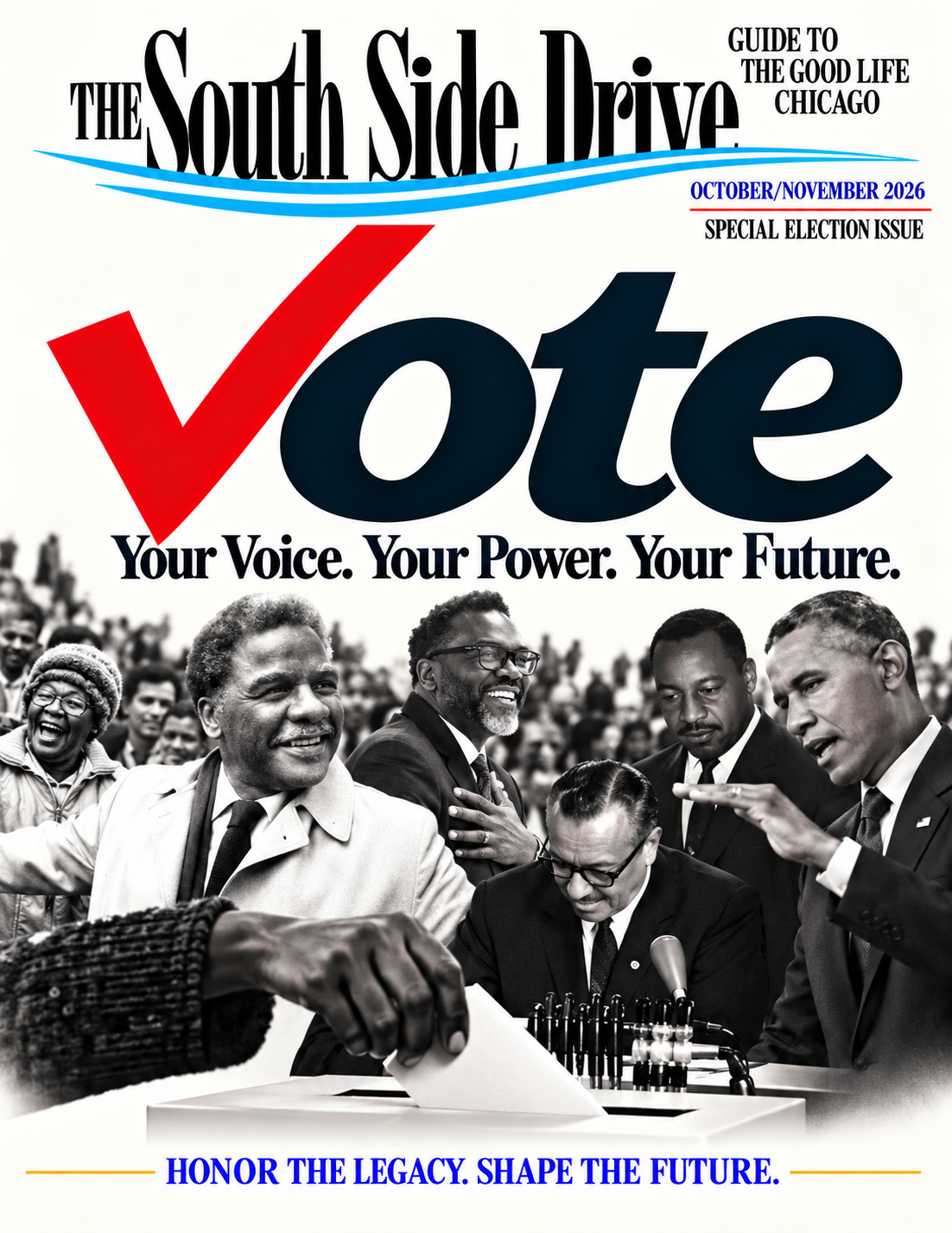
I remember what an election season once felt like in Chicago. During Harold Washington’s campaigns for mayor, politics did not arrive primarily through a screen. It moved through neighborhoods. It entered churches, union halls, barbershops, beauty salons, taverns, community centers, grocery stores and apartment buildings. People registered their relatives, called their neighbors, carried petitions, distributed literature, organized precincts and brought others into the work. The campaign was not merely asking people to vote. It was building and activating people power.
Barack Obama’s campaigns represented something important: the last moment when digital tools were explicitly designed to serve organizing rather than replace it. Email and social media directed volunteers toward field offices. Online networks converted strangers into coworkers.
Digital tools helped direct the work, but they did not pretend to be the work.
Today, we possess communications tools that dwarf what was available then. A message can reach millions of people in seconds. Registration links can be distributed instantly. Volunteers
can be located, trained and connected without entering a national headquarters. Yet our capacity to communicate has expanded while our capacity to organize appears to have contracted.
A hashtag cannot look someone in the eye. A QR code cannot listen to a voter explain why she has stopped believing elections matter. Technology can distribute information, collect names
and process donations. But it cannot replace the trust produced by one human being saying to another: I know what you are facing. I know why this election matters. I am going to help you participate, and I will come back.
A hashtag cannot look someone in the eye.
The Algorithm Has Captured Activism
Much of contemporary activism appears to have been captured by the algorithm. Politics has been reduced to a continuous stream of provocation and response. A right-wing personality
says something outrageous. An influencer produces an indignant reply. The reply becomes a headline. People share it, argue beneath it and experience the brief satisfaction of seeing
someone “destroyed” online. Then the machinery moves on to the next outrage.
An influencer bad-mouthing a provocateur should not constitute political news. It does not register anyone. It does not correct a polling location. It does not train a precinct captain, protect a ballot or create a durable relationship among people who must continue living together after
the post has disappeared.
The algorithm rewards the immediate, emotional and antagonistic. Organization requires patience, repetition and responsibility. The influencer succeeds when people watch. The organizer succeeds when people act without needing to be watched.
The influencer succeeds when people watch. The organizer succeeds when people act without needing to be watched.
The chilling of the vote does not begin on Election Day. It begins when people are exhausted by politics, uncertain about the rules, distrustful of institutions and unconvinced that participation
can materially improve their lives. A chilled electorate does not announce that it has been suppressed. People simply withdraw. They miss a deadline. They do not check their registration. They assume someone else will stop what is happening. They remain home.
That is why registration by itself is not enough. Organization surrounds a person with information, relationships, transportation, protection, purpose and expectation. It connects the ballot to rent, employment, health care, schools, immigration, reproductive freedom and public safety. It turns an isolated voter into a member of a constituency capable of making demands before and after an election.
The Real Organizing Happening Now
But there is something else happening in this country right now—something that reveals how organizing actually works.
People in urban neighborhoods, suburbs, small towns and farming communities are organizing against the unchecked proliferation of data centers.
They are attending zoning hearings, examining utility agreements, investigating tax abatements, forming neighborhood organizations, gathering signatures, forcing referendums and making these projects into election issues.
Dy
This may be the most immediately engaging political activity in the country today. Opposition to data centers crosses boundaries that divide nearly every other national issue. A recent Gallup poll found that seven in ten Americans oppose the construction of an AI data center near where they live. That degree of agreement is extraordinary in contemporary politics. And this sentiment is becoming organized action.
In Monterey Park, California, organizers conducted a multilingual campaign, distributing materials in English, Spanish and Chinese. Approximately 86 percent of voters approved a measure prohibiting new data centers, making Monterey Park the first American city to enact a permanent citywide data-center prohibition through a public vote. In Virginia, John McAuliff made data-center development central to his House of Delegates campaign. He defeated a Republican incumbent in a district where the issue had mobilized voters across party lines. In Georgia, rising electricity bills helped propel Peter Hubbard and Alicia Johnson to rare statewide victories on the Public Service Commission.
This organizing is visible across Illinois. Near Pekin, opposition to a proposed data center produced a Facebook group with approximately 2,500 members. Residents filled public meetings and raised questions about environmental effects, utility rates, noise and the project’s economic benefits. Pekin officials sought additional information from the developer and scheduled a public town hall. In Madison County, voters in Chouteau, Granite City, Nameoki and Venice townships will consider advisory questions about permitting data-center construction on the November ballot.
I know this organizing firsthand. Working with musician and composer Nicole Mitchell, I helped organize an anti-data-center event in Henderson, North Carolina. Email and text messages
made coordination possible across thousands of miles. But the technology was only connective tissue. It brought actual people and existing organizations into a common undertaking. The objective was never to accumulate likes but to create an event, share reliable information, connect groups that had been working separately and strengthen the community’s capacity to act.
The coalition has continued its work. According to Data Center Watch, citizen opposition blocked or delayed at least 75 projects representing approximately $130 billion in proposed construction during the first quarter of 2026 alone. This is not symbolic activism. It is an exercise of power.
The technology was only connective tissue. It brought actual people
and existing organizations into a common undertaking.
The Next Step: Connect Local Organizing to the Ballot
Many of these campaigns have not yet systematically registered unregistered voters, checked the registration of their members, organized entire precincts or connected their local struggles to the complete November ballot.
That is the unrealized opportunity.
Every data-center petition table should provide a way to register or verify registration. Every town hall should explain which public officials control zoning, utilities, tax incentives and water.
Every local coalition should identify the offices appearing on November’s ballot and ask candidates to state their positions. Every volunteer list should become a relational organizing network capable of contacting members before early voting and Election Day.
We do not need to wait for a national institution to announce the movement. The organizations already exist. Chicago Votes, Rainbow PUSH, CHANGE Illinois, ICIRR, the League of Women Voters, local NAACP branches, unions and neighborhood organizations are all doing this work.
Nationally, Black Voters Matter, Reclaim Our Vote, Vote.org and election-protection coalitions are in place.
What remains is the act of connection.
Begin with the people you know. Speak to relatives, neighbors, coworkers and congregation members. Do not begin by forwarding a link. Begin with a conversation. Ask whether they are
registered at their current address. Ask what issue is affecting them directly. Ask whether they have made a plan to vote.
Then find the people already working. Do not simply ask an organization what it intends to do. Ask what you can do this week. Can you register voters? Can you take responsibility for your building or block? Can you host a meeting of ten people? Can you call 25 neighbors? Can
you provide transportation?
Use the algorithm, but refuse to live inside it. Use social media to announce a real meeting.
Use a QR code to register a real person while standing beside them. Every digital communication should lead somewhere beyond the screen.
This work must continue after registration. Check that forms were processed. Help people learn what is on the entire ballot. Arrange transportation. Contact people again. Protect the vote.
We face two critical elections. Illinois’s general midterm election arrives Nov 3, 2026—the moment to translate local organizing into votes that can shift public policy. Chicago’s municipal election follows on Feb 23, 2027, with a possible runoff on Apr 6, 2027. The relationships built around the November ballot can become the neighborhood infrastructure through which residents question mayoral and aldermanic candidates, demand commitments and hold the winners accountable after Election Day.
These are the dates that matter. There is enough time for every church, union local, block club, college and community organization to take responsibility for a circle of human beings and prepare for what comes next.
The vote is being chilled by isolation and the substitution of digital performance for political relationships. We heat it up by coming into one another’s presence. One conversation, one household, one block and one precinct at a time.
We heat up the vote by coming into one another’s presence—one conversation, one household, one block and one precinct at a time.
Only people can organize people.