

Chicago’s public-school history is often described as a succession of reforms. But for many Black families, particularly those on the South and West sides, it has felt more like a succession of experiments—each introduced as the answer to inequality, yet too often leaving neighborhood children to bear the consequences.
When Benjamin C. Willis became superintendent of Chicago Public Schools in 1953, the city’s Black population was rapidly increasing. Restrictive housing practices, and overcrowded neighborhoods, led to overcrowded schools.
Instead of redrawing attendance boundaries or permitting Black children to enroll in nearby white schools with available space, Willis placed portable aluminum classrooms beside overcrowded Black schools. Critics called the trailers “Willis Wagons.”
Thousands of students and parents marched, demanding Willis’ removal. He left CPS in 1966.
A grassroots movement helped win passage of the Chicago School Reform Act of 1988, which created more than 500 Local School Councils, giving parents, teachers and community members significant authority over school budgets, improvement plans and the hiring and evaluation of principals. That movement was partially reversed in 1995 when Mayor Richard M. Daley gained direct control of CPS and appointed his city budget director, Paul Vallas, as the district’s first chief executive officer as opposed the traditional title of supervisor because had had no experience as an educator. Instead of focusing on maintaining the neighborhood school as the glue they kept Black neighborhoods flourishing Vallas focused on balancing the budget. Under his leadership, vocational schools such as Dunbar and CVS no longer taught the skills that for years enabled high school graduates who did not go on to college the ability to establish careers in the trades.
Charter schools, selective-enrollment, magnet and military programs expanded, drawing high-achieving students, funding and resources away from neighborhood schools.
The handling of George Washington Carver High School illustrates the human
consequences.
Carver, the neighborhood high school serving Altgeld Gardens and the surrounding Far South Side was converted into Carver Military Academy. Altgeld Gardens teenagers who didn’t qualify or accept its military structure, were directed to Fenger High School, nearly five miles away. The route crossed neighborhood and gang boundaries. A gang conflict at Fenger in 2009 resulted in the beating death of 16-year-old Fenger student Derrion Albert.
Beginning in 1995, Daley and Vallas began skipping required payments to the
Chicago Teachers’ Pension Fund and using those funds for district operations.
As teachers continued making their required contributions, the pension fund continued to be severely underfunded and teacher benefits, not the government’s skipped payments, were blamed for the crisis.
In 2004, “underperforming” schools were closed and replaced by charters,
contract schools or smaller specialty programs. Local School Council authority was removed, and experienced Black educators were displaced, further weakening traditional neighborhood schools.
In 2011, Rahm Emanuel became mayor and his appointed Board of Education
closed 50 schools. Most were elementary schools in Black communities on the South and West sides.
In 2012 the Chicago Teachers Union began building alliances with parents and community organizations and pushing for smaller classes, nurses, librarians, counselors, social workers, affordable housing and services addressing homelessness and trauma. The debate, no longer limited to test scores and whether a school should be closed, began to include what children need before they can learn and what government owes to communities that have endured generations of disinvestment.
The Sustainable Community Schools was created to strengthen struggling schools by adding mental-health care, after-school programs, restorative justice, family support and community partnerships. In August 2026, CPS announced that the program had expanded to 51 schools, with additional schools planned.
In January 2025, Chicago had a new mayor and a 21-member hybrid Board of
Education. Following the November 2026 election, Chicago is scheduled to have a fully elected board beginning in January 2027. The elected board creates a new avenue for public accountability. The true measure of success will be whether every child can attend a safe, well-funded, academically strong school in his or her own community.
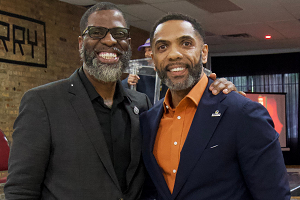
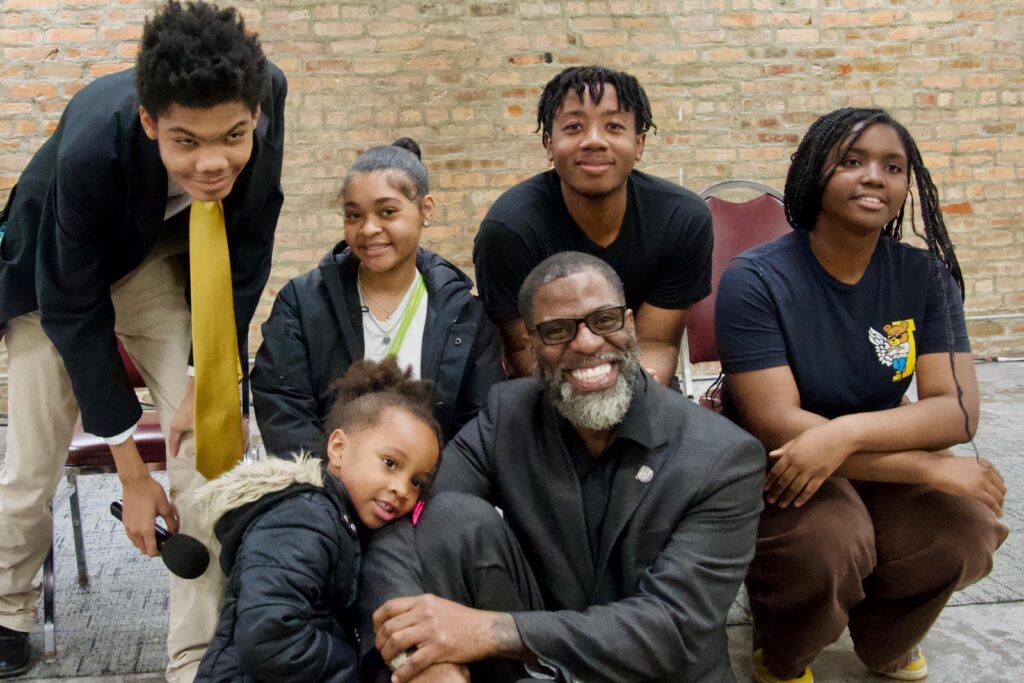
That remains the unfinished work of Chicago public education. Yet, with Sean B.Harden (pictured) as president of the Elected School Board, and Che “Rhymefest” Smith, (pictured with Harden and with children) elected to District 10 of the School Board, which covers Bronzeville, Hyde Park,Woodlawn, and South Shore) and the Chicago Teacher’s Union fighting for children and neighborhood schools, the future of CPS looks very hopeful.