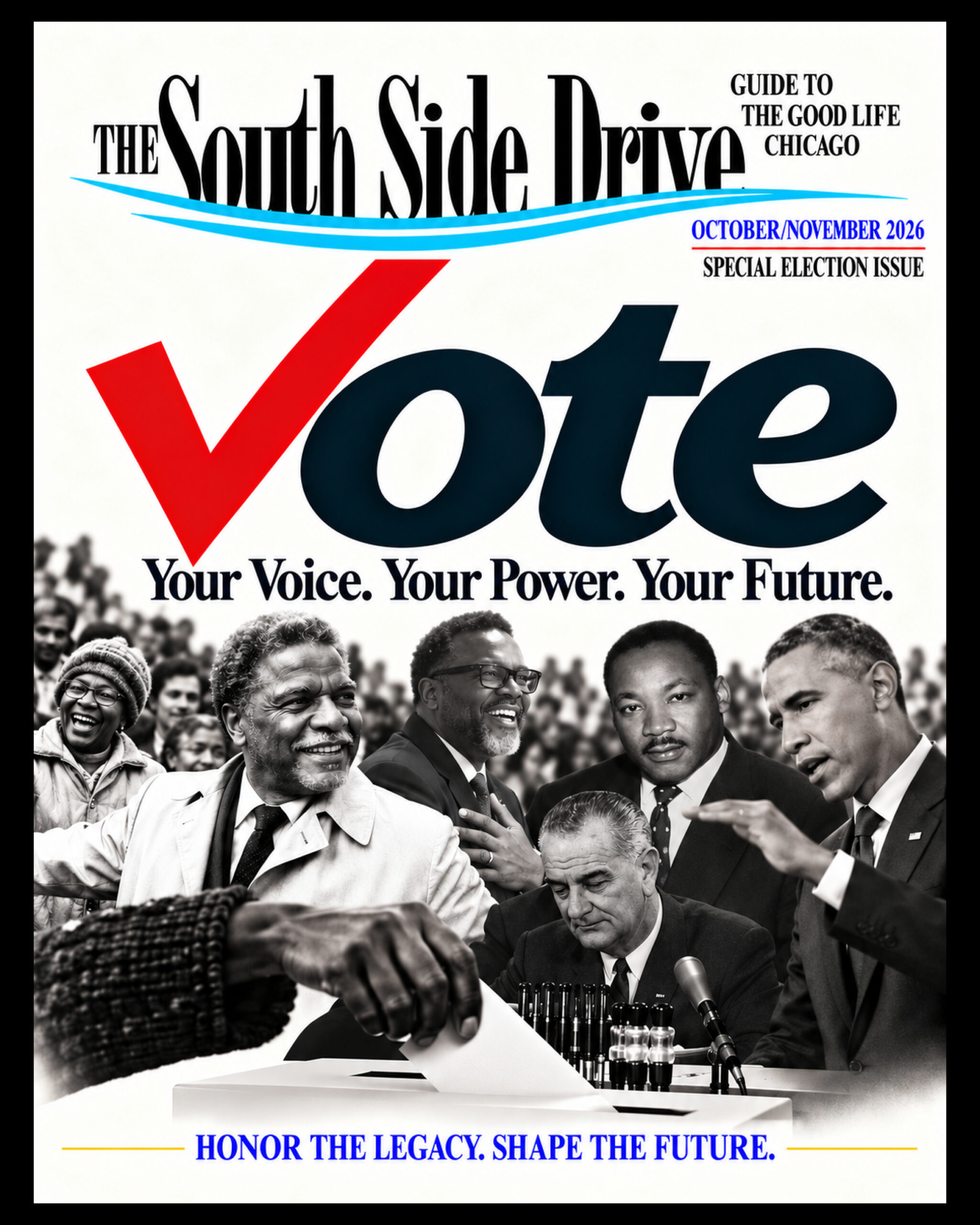


Editor’s Note (Mother’s Day)
As we celebrate Mother’s Day this month, we often expand the gallery of familiar names. This essay asks a different question: how have we filtered which women are remembered at all? On Chicago’s South Side, two Black women built political infrastructures that reached across oceans — and were engineered out of the memory of the movements they helped create.
Engineered Silence on King Drive
Mittie Maude Lena Gordon, Pearl Sherrod, and the Architecture of Respectable Memory
On Mother’s Day, we are asked to remember.
But memory, like history, is never neutral.
We are handed a familiar gallery—names polished, stories softened, legacies made safe for repetition. This day invites gratitude, yes. But it also invites a harder question: who gets remembered as a mother at all—and who is edited out of the lineage?
On Chicago’s South Side, along King Drive, two Black women built political infrastructures that stretched beyond the boundaries of nation and time. Their work moved across oceans. Their vision exceeded the limits placed on them. And yet, the memory of the movements they helped create has been carefully arranged—engineered, even—to leave them at the margins. Motherhood is often reduced to intimacy, to the private sphere. But for women like Mittie Maude Lena Gordon and Pearl Sherrod, motherhood was also political architecture. It was strategy. It was the building of networks, institutions, and futures large enough to hold a people. This Mother’s Day, we honor not only the mothers we are taught to name—but the ones whose names were made difficult to remember.
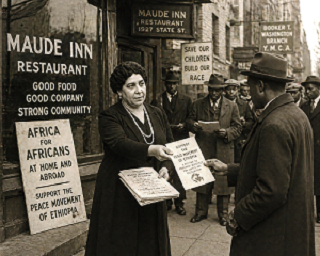
On 47th Street, the dining room at Peaches fills with the scent of duck bacon and peach bourbon sauce, folding into the steady rhythm of traffic along Martin Luther King Jr. Drive. Families pass plates. Laughter rises. It is the sound of continuity.
Nothing on the building suggests it once housed an experiment in Black international power.
In the 1930s, a Black woman used this storefront to coordinate one of the largest nationalist organizations in interwar America. From here, she built dues-paying membership rolls, organized mass petition campaigns, corresponded across the Atlantic, and compelled federal authorities to respond.
There is no plaque.
No marker.
No municipal recognition.
The absence is not random.
It follows patterns — what gets archived, what gets monumentalized, what is allowed to fade.
The woman was Mittie Maude Lena Gordon.
And the silence surrounding her reflects an architecture shaped by state surveillance, institutional archiving, and segments of the Black middle class navigating genuine threats while seeking institutional footholds.
Some histories are framed as respectable. Others drift.
This is not simply a forgotten biography.
It is a study in how memory narrows.
Infrastructure, Not Iconography
Mittie Maude Lena Gordon founded the Peace Movement of Ethiopia (PME) in Chicago in the early 1930s. At its height, the organization claimed tens of thousands of members nationwide, with a substantial base on the South Side. It developed chapters across multiple states and operated through disciplined, dues-paying membership structures that required steady administrative coordination.
This was not rhetorical nationalism.
It was institutional architecture. The PME collected dues, maintained formal membership rolls, organized conventions, circulated petitions to federal officials, and advocated voluntary migration to West Africa. More fundamentally, it framed Black Americans as a diasporic people with international political standing. Gordon’s petitions urged the U.S. government to negotiate land for settlement — not as charity, not as exile, but as geopolitical recognition.
Her correspondence crossed oceans. She wrote to Liberian officials and situated Black American migration within global diplomacy. She treated African sovereignty as inseparable from Chicago’s South Side.
This was geopolitics built from a neighborhood storefront.
Historian Keisha N. Blain, in Set the World on Fire, demonstrates that after Marcus Garvey’s deportation, Black nationalist internationalism did not collapse. It decentralized — and women sustained its machinery. Garveyism’s afterlife was administrative, not theatrical.
Machinery rarely makes the monument.
Charisma does.
Gordon did not conform to the iconographic model of leadership. She built systems. She sustained networks. She understood that movements require ledgers, mailing lists, correspondence chains, and durable infrastructure.
She practiced administrative sovereignty.
When the State Took Notice
The federal government understood her scale.
In September 1942, amid wartime panic and expanded federal policing powers, authorities conducted raids across Chicago and other cities targeting individuals suspected of sedition or foreign sympathies. Gordon was swept into that climate.
On October 3, 1942, the Chicago Defender ran a banner headline that did not name Gordon — but named her world:
“CULTISTS DEFY COMMISSIONER NO. S. COURT — White Civilization Is Doomed, Shouts A
Jap Sympathizer.”
The article collapsed multiple organizations into a single threatening category. Gordon’s movement was caught in that net — not singled out, but stained by proximity.
This is how institutional erasure often works: not through direct accusation but through associative contamination. The organization becomes unspeakable before it becomes unremembered.
Wartime compresses nuance.
Internationalism becomes foreign allegiance.
Migration becomes subversion.
Critique becomes treachery.
The most serious sedition charges in Chicago ultimately failed to produce convictions.
But public framing rarely evaporates with legal resolution.
Surveillance files remain.
Organizational systems do not.
What we know about Gordon survives largely because the state was afraid of her. FBI files endure because she was watched. Defender coverage survives because she was publicly framed. The movement’s own ledgers and private correspondence — the administrative record of Black self-determination — are fragmentary or gone.
The archive of the repressed is often the archive of the repressor.
We see Gordon most clearly through the eyes that sought to contain her.
The accusation survives.
The infrastructure disappears.
The Gendering of Structure
Administrative labor has long been feminized — coded as supportive rather than strategic, maintenance rather than leadership. Yet without administration, movements collapse.
Women like Gordon mastered continuity. They were not assisting history.
They were building it.
Historical commemoration favors rupture. It prefers the speech over the spreadsheet, the rally over the roll call, the singular male figure over the distributed female network.
This preference is rarely announced. It operates as narrative gravity. Charisma is easier to monumentalize than infrastructure.
Because women disproportionately carried administrative labor, they are disproportionately absent from monumental memory.
Pearl Sherrod and Transnational Feminist Nationalism.
The same narrowing operated within religious and transnational nationalism.
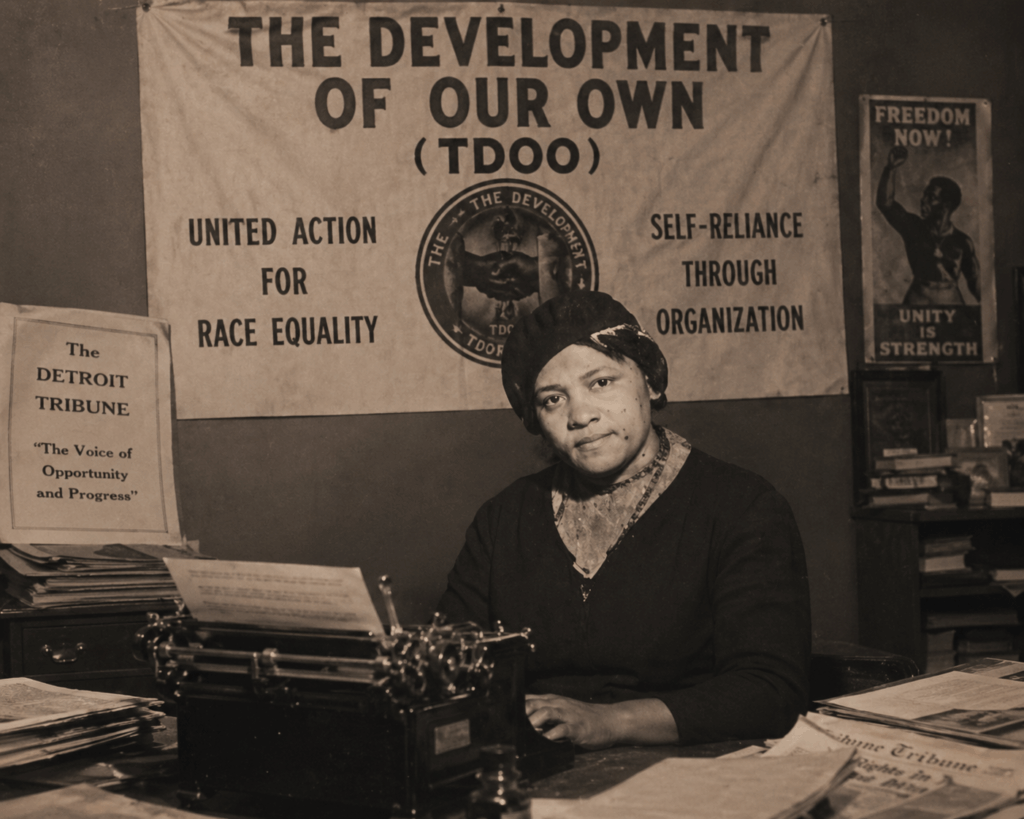
Pearl Sherrod was based in Detroit, where she led The Development of Our Own (TDOO), an organization advocating Afro-Asian solidarity. She wrote for the Detroit Tribune Independent, linking Black American struggles to global anti-colonial movements.
In July 1937, she drove from Detroit to Vancouver to attend the Pan-Pacific Women’s Association conference — a gathering originally designed for white and Asian women of the Pacific Rim. She was not invited.
She insisted on entry.
She became the first African American woman to address the conference, linking lynching in the American South to the global struggles of the “darker races” and calling for Afro-Asian alliances.
She was not peripheral.
She was foundational.
She also studied under W. Fard Muhammad and alongside Elijah Muhammad in the formative years of the Nation of Islam.
The organization she helped seed would eventually anchor itself along the same South Side corridor — its mosque on Stony Island, a few blocks east of where Gordon organized on 47th — while her name disappeared from its founding memory.
For a South Side reader, that geography is not abstract.
Yet as authority consolidated around a theology of Black masculine restoration, women’s formal leadership narrowed. Sherrod had helped build the intellectual and organizational foundation of what would become one of the most explicitly patriarchal institutions in Black American religion — and was edged out as that institution calcified.
Movements incubated by women’s labor frequently masculinize their authority once stability is achieved and respectability is sought.
Sherrod was not peripheral to that founding.
She was its surplus.
Respectability, Survival, and Chicago’s Filter
The shaping of memory is not solely a matter of conspiracy or drift.
It is patterned.
The state surveils radical movements and archives repression. Institutional memory elevates figures whose politics can be reconciled with national myth.
Segments of the Black bourgeoisie, navigating genuine threats and seeking institutional footholds, often privileged narratives of uplift over separatist internationalism.
In Chicago, institutions like the Urban League and the Defender — essential to Black civic life and themselves under pressure — tended to frame migration advocacy as defeatism and internationalist nationalism as dangerous eccentricity.
The Defender, which had championed the Great Migration northward, drew the line at voluntary
return.
The pressures were real.
The choices were constrained.
The narrowing followed.
What It Costs
What disappears is not only biography.
It is method.
Working-class Black communities once sustained dues-based, women-led, internationalist movements from storefront headquarters — and understood that federal repression targeted administrative capacity first: the ledger, the mailing list, the chapter structure.
When that knowledge fades, the repertoire narrows.
Spectacle fills the vacuum that infrastructure once occupied.
Charismatic leadership.
Viral mobilization.
Episodic protest.
The violence operates quietly.
Through foreclosure.
Through absence.
Through engineered silence.
The Building Still Stands
Peaches Restaurant still stands on King Drive.
Inside, new generations gather without knowing what once transpired within those walls.
And yet the silence has not been total. There are still a few of us who remember — through acquaintance, through neighborhood memory, through stories told without citation but not without weight. At seventy-two, I am aware that the distance between lived memory and archival record is narrowing. What was once common knowledge risks becoming academic footnote.
The work now is not only to critique erasure but to interrupt it.
A plaque would not canonize every position Gordon held.
It would acknowledge that administrative sovereignty — the capacity to build ledgers, chains of correspondence, and durable networks outside state sanction — was practiced here.
And that it was deliberately unmade.
An engineered past produces engineered limits.
It reduces the scale at which we believe we can act — the ambition at which we dare to imagine.
And if we allow that narrowing to continue, the loss will not belong to history.
It will belong to us.
Notes & Citations
Blain, Keisha N. Set the World on Fire: Black Nationalist Women and the Global Struggle for Freedom. Philadelphia: University of Pennsylvania Press, 2018.
Blain, Keisha N. “Pearl Sherrod and the Pan-Pacific Women’s Association.” Souls: A Critical
Journal of Black Politics, Culture, and Society.
Chicago Defender, October 3, 1942, coverage of federal sedition proceedings.
Clegg, Claude Andrew III. An Original Man: The Life and Times of Elijah Muhammad. New York:
St. Martin’s Press, 1997.
Taylor, Ula Y. The Promise of Patriarchy: Women and the Nation of Islam. Chapel Hill: University
of North Carolina Press, 2017.
Further Reading
• Erik S. McDuffie, Sojourning for Freedom
• Martha S. Jones, Vanguard
• Ula Y. Taylor, The Promise of Patriarchy