

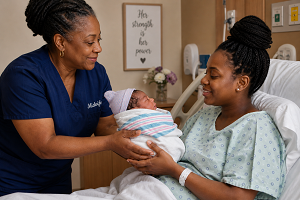
Childbirth is supposed to be a celebration. But for Black women in America, it remains a fight for survival – and a community of advocates, lawmakers and midwives is refusing to accept that.
In Libya, under Muammar Gaddafi, the government handed every new mother $5,000 – a cash salute to the miracle of new life. In a Baptist church on Chicago’s South Side, a preacher stops the service mid-sermon, asks his congregation to take each other’s hands, and says “You are holding the hand of a miracle.” And there is a famous scene from the television series Roots, seared into the cultural memory of a generation, in which a father lifts his newborn into the night sky and declares, “Behold, the only thing greater than yourself.” Across cultures and centuries, people greet childbirth with awe. It is a thing to celebrate, to protect, to honor. And yet, if that baby is born to a Black mother in the United States of America, the statistics tell a quite different story – one of neglect, disparity, and a crisis that has roots stretching back to the very beginning of this nation.
A Wound that Never Fully Closed
To grasp our current situation, we need to examine the past more deeply than usual. During American slavery, an estimated 50 percent of enslaved infants were stillborn or died before their first birthday. Enslaved women were not patients, they were property. Their bodies were sites of labor and experimentation, not healing.
After Britain and the United States banned the transatlantic slave trade in 1807- 1808, plantation owners suddenly had a vested economic interest in the health of enslaved women and their children already in the country. While the plantation owners called the white physicians in for difficult births – not out of compassion, but because a living, healthy infant meant profit — that brief, cynical window of medical attention slammed shut when enslaved people were emancipated. With no financial stake in their survival, scientists turned their bodies into test subjects. Physicians practiced new surgical and gynecological techniques on sick enslaved women– continuing until their subjects were either cured or died.
The history is not ancient or irrelevant. It is the foundation of American medicine. And its echoes are measurable today: Pregnancy-related mortality rates for Black women are 3.4 times higher than those of white women in the U.S.
In 2016 the CDC reported that Black infant mortality rates were 2.3 times higher than white infants – which is higher than it was in 1850 when the Black infant mortality rate compared to whites was 1.6 times higher. Read that again. In 1850 Black infants died at a rate 1.6 times higher than white infants. In 2016, that ratio grew to 2.3. With all modern medicine’s advances – electronic monitoring, neonatal intensive care, evidence-based obstetrics – Black mothers and babies are doing worse relative to their white counterparts today than they were before the Civil War.
When Doctors Do Not Listen
The underlying cause of these disparities, researchers and advocates say plainly racism.
According to the Black Mama’s Matter Alliance, when Black mothers report pain or concerning symptoms to their doctors, their complaints are routinely dismissed, minimized, or ignored. This is not anecdote – it is documented pattern. The phenomenon has a name: racial pain bias. And it has a long, ugly medical history.
For generations, it was an accepted – and taught – myth in American medicine that Black individuals experience less pain than white individuals. This belief, rooted entirely in racist pseudoscience, influenced how physicians treated (or did not treat) Black patients for more than a century. Studies have shown that the myth persists even today among medical students and residents.
The John Hopkins Bloomberg School of Public Health identifies several interconnected drivers of these disparities. Structural racism and implicit bias lead to lower-quality care and health concerns that go unaddressed. Social determinants – unstable housing, limited transportation, food insecurity, economic inequality – compound the medical risk. Higher baseline rates of chronic conditions like hypertension raise the stakes of every pregnancy. And Black women are more likely to experience postpartum depression while being far less likely to receive treatment for it. The result is a brutal math: higher rates of preeclampsia, post- partum hemorrhage,and cardiovascular complications, and too many funerals where there should be birthday parties.
The crisis did not go uncontested.
In 1970 when Black maternal and infant mortality was a subject for medical journals, not public conversation, the Black Panther Party opened the People’s Free Medical Clinics. Dismissed by mainstream America as a radical organization, the Panthers built what historians now describe as “sites of social change:” community health spaces that centered Black mothers and children, which celebrated Black life rather than treating it as expendable. Their vision was radical then. It reads today as simply correct.
Cook County Commissioner, Donna Miller, who is currently the Illinois Democratic Senate Nominee, states:
“Affordable health care access and equity are my top priorities. The Black community is disproportionately impacted by the high incidence of maternal and infant mortality, which is 90 percent preventable.”
Miller has secured millions for reproductive care access in Illinois and led Cook County efforts to fund doula programs and reduce maternal health disparities. Her model legislation is now being adopted by countries across the nation.
Democratic Party of Illinois Chair, Lisa Hernandez, says:
“It is the duty of Illinois Democrats to help eliminate discrimination in health care, stop preventable deaths, and get pregnant people and their babies the comprehensive care they need.”
Illinois has become an unlikely and important case student in what states can do when they take Black maternal health seriously. In recent years, the state has moved from acknowledgement to legislation, enacting a suite of policies that advocates are calling a genuine model.
(DARNELL – PLEASE BULLET POINT THE NEXT FOUR PARAGRAPHS)
The Birth Equity Act (2024) requires insurance companies to cover doulas, lactation consultants, home visitors, and other community-based care providers.
The Illinois Birth Equity Blueprint was released as a comprehensive roadmap to improve maternal health care and birth outcomes statewide.
New legislation enables the licensure and certification of midwives across Illinois, expanding the workforce of community-based birth professionals.
The Illinois Perinatal Quality Collaborative Partnership engages hospital teams in targeted strategies to reduce maternal health disparities and morbidity.
Each of these policies addresses a specific failure point. Extending Medicaid coverage to twelve months recognizes that the postpartum period is medically critical – and that cutting off coverage at two months abandoned mothers precisely when complications often emerge. Covering doulas acknowledges what research has long shown: continuous labor support dramatically improves outcomes, particularly for Black women who face bias form clinical staff.
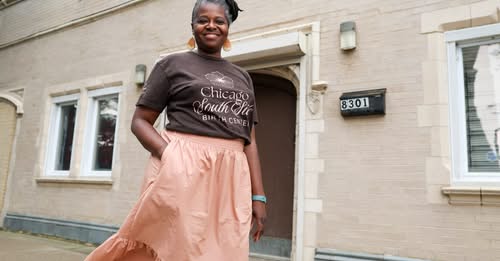
In April 2026 on Chicago’s South Side, something historic happened quietly -groundbreaking for the Chicago South Side Birthing Center, the first independent, freestanding birth center on the southside of the city.
The center is the culmination of years of advocacy by Jeanine Valrie Logan, who did not just dream about what community-centered birth care could look like – she helped draft the state law that made it possible. The Alternative Health Care Delivery Act expanded Illinois’ limit on operating birth centers from twelve to seventeen, giving Jeanine Valrie Logan the legal opening she needed to build something new.
The center’s philosophy is explicit: culturally centered, community-focused midwifery care. Not just clinical care – though it will provide that – but a space that affirms, celebrates, and supports Black motherhood. A place designed with the understanding that one cannot separate medical outcomes from how patients are seen, heard, and valued.
The Black community is disproportionately impacted by the high incidence of maternal and infant mortality, which is 90 percent preventable.
Ninety percent preventable. The deaths. The complications. The trauma. Ninety percent of it is preventable. We have the knowledge. We have the interventions. What has been missing, what has always been missing in the political landscape, is to extend them equally.
Although Illinois cannot offer $5,000 for every newborn as Libya does, what they can offer is something much more durable: a system that sees Black mothers clearly, listens to them more genuinely, and fights for their survival with the same urgency it has always reserved for others. That’s what the advocates, midwives, commissioners, and birth justice workers are building right now. That’s what the Chicago South Side Birthing Center is all about.
In a little Baptist church on the South Side, the preacher was right. Every hand you hold is a miracle. This Mother’s Day, mothers-to-be can celebrate bringing the miracle of life into this world in a much healthier way.