

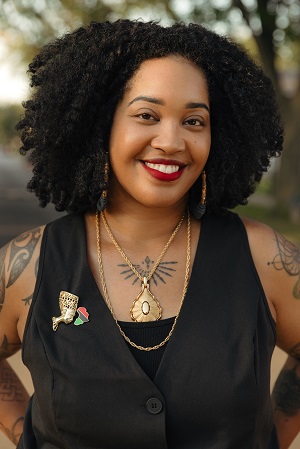
How photographer and activist Tonika Lewis Johnson turned love for her neighborhood into a MacArthur Genius Award — and why she’s not going anywhere.
The phone call came while Tonika Lewis Johnson was driving. The voice on the other end — a representative from the MacArthur Foundation — asked her to pull over. She saw no reason to. Then came the news: she had been awarded the MacArthur Fellowship, the prestigious prize colloquially known as the Genius Award, and with it, an unrestricted $800,000 grant.
Her first words? “You’re lying.”
She pulled over.
For Johnson, a photographer, multimedia artist, and relentless community advocate who has spent the better part of two decades using art to expose inequality and ignite pride in Chicago’s Englewood neighborhood, the recognition was both a surprise and a vindication. The MacArthur Foundation’s reviewers had been quietly canvassing people who knew her — conducting interviews, swearing sources to secrecy, even requiring signed NDAs. All the while, Johnson had no idea that it was coming.
Growing Up in Englewood — and Coming Back
Creativity ran through Johnson’s family like a current. Her father was an amateur photographer. Her maternal grandmother and her uncles were gifted artists. Her mother, Rita Lewis, carved out a respected place in Chicago’s film community as a writer and producer and eventually a literary agent— at one point, she was so committed to a client’s project that she produced a film short featuring celebrated Chicago-based actor Irma P. Hall and bringing acclaimed actor, Harry Lennix, to Chicago to star in it.
Johnson absorbed it all. On her 12th birthday, her mother gave her a piano. “I played it even when I didn’t feel like it, “she has said, because it was such a wonderful gift.” Her daily commute from Englewood to her northside high school, Lane Technical High School, jump-started her Folded Map idea. As a high school student, she joined Young Chicago Authors – a four-year writers’ program that introduced her to photography – and earned a scholarship into a competitive writing program.
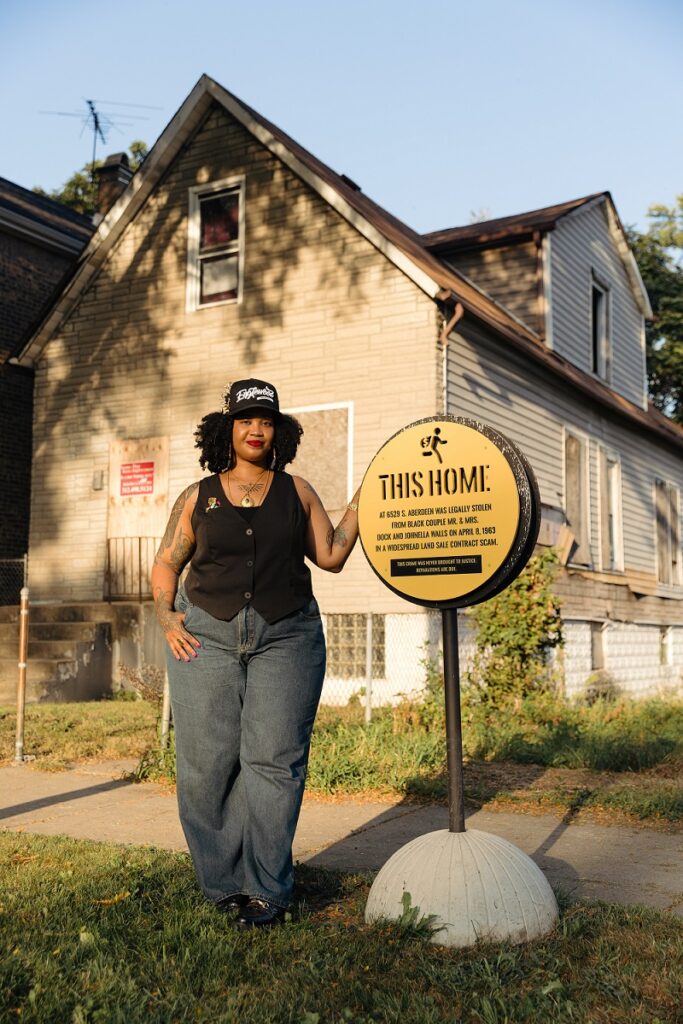
In her early twenties, she and her husband went house hunting. They couldn’t afford the neighborhoods they’d hoped for, so they returned to Englewood, where she had grown up. The move changed her. “As an adult, I looked at my community through a completely different lens,” she explains. She saw a neighborhood of resilient people, tightly knit bonds, and deep history — but she also saw something else: the predatory real estate tactics,
the disinvestment, the disparities in infrastructure and services that had nothing to do with the character of the people who lived there. “The condition of the community,” she says with quiet conviction, “wasn’t the fault of the residents.”
Art as a Map to Justice
Johnson responded the way artists do — she made work. After the 2016 presidential election, as Chicago was being nationally vilified for its gun violence statistics, she channeled her frustration and her camera into something powerful: the Folded Map Project.
The concept is as elegant as it is damning. When a Chicago city map is folded in half, north meets south — and identical street addresses align. The Folded Map Project pairs these “map twins:” neighbors in name only, living on the same street number but separated by miles and by the stark racial and economic fault lines that divide the city. A street on the wealthy North Side mirrors a street in Englewood. The photographs Johnson makes, the conversations she facilitates between these paired residents, expose the inequity not as abstraction but as lived geography.
The project drew national attention and earned Johnson a place on Chicago Magazine’s Chicagoans of the Year list in 2017. It cemented her reputation as an artist with a social scientist’s eye and an organizer’s heart.
But photography was only the beginning. Johnson also co-founded the Englewood Arts Collective and launched Unblocked Englewood, a housing and public art initiative aimed at restoring a single block in the community — one brick, one mural, one family at a time. She serves on Chicago’s official Reparations Task Force, sits as a 2025 Pritzker Fellow at the University of Chicago’s Institute of Politics, and was named a 2024 Gordon Parks Foundation Fellow. The American Red Cross recognized her with a 2025 Social Justice Impact Hero Award, and Architect Magazine named her in its prestigious “Game Changers” issue.
Freedom, Stability — and Staying Put
When asked what the MacArthur money means to her, Johnson doesn’t reach for grand ambitions. She reaches for something quieter and more essential: freedom and stability.
She’ll no longer need to depend on speaking engagements to pay her bills. She’ll have flexibility — to work on what matters, at the pace that matters, without scrambling.
And she will not be leaving Englewood.
“I love my neighborhood,” she says simply. “And I’m here to stay.”
In a city that has spent decades telling Englewood what it lacks, Tonika Lewis Johnson has spent her career showing the world what it holds. With a genius award in hand and roots sunk deep into the same South Side soil she grew up on, she’s not finished yet.
MacArthur Fellowship, popularly known as the “Genius Grant,” is a prestigious $800,000 no-strings-attached award granted annually by the MacArthur Foundation to roughly 20-30 individuals. The $800,000 stipend is paid over five years with no obligations or reporting requirements, allowing fellows to pursue their creative, intellectual and professional pursuits. It recognizes exceptionally creative, original, and dedicated people across various fields—from arts to sciences—who show significant promise for future breakthroughs.