

Editors note: This article initially appeared in In These Times Magazine in 1998..
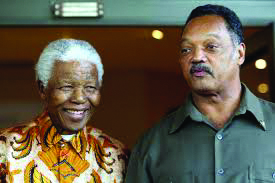
The Rev. Jesse Jackson finally got a job. On October 10, he was sworn in as the U.S. government’s special envoy to Africa. Actually, it’s not a real job—the appointment is pro bono. But getting paid has never been Jackson’s top priority. The 56-year-old Jackson now has one of the most recognizable faces in the world, and his appointment as President Clinton’s point man for Africa shows how much influence he wields.
Jackson has the support of most Black organizers—including pan-African nationalists. “Jackson’s appointment is a very important one,” says Conrad Worrill, chairman of the National Black United Front, a confederation of the country’s Black nationalist organizations. “He’ll have the rare opportunity to shine a spotlight on the need for closer connections between Africans and African-Americans. And that link will become increasingly important as we move into the 21st century.”
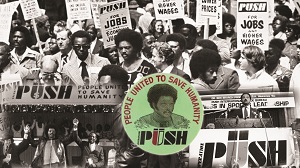
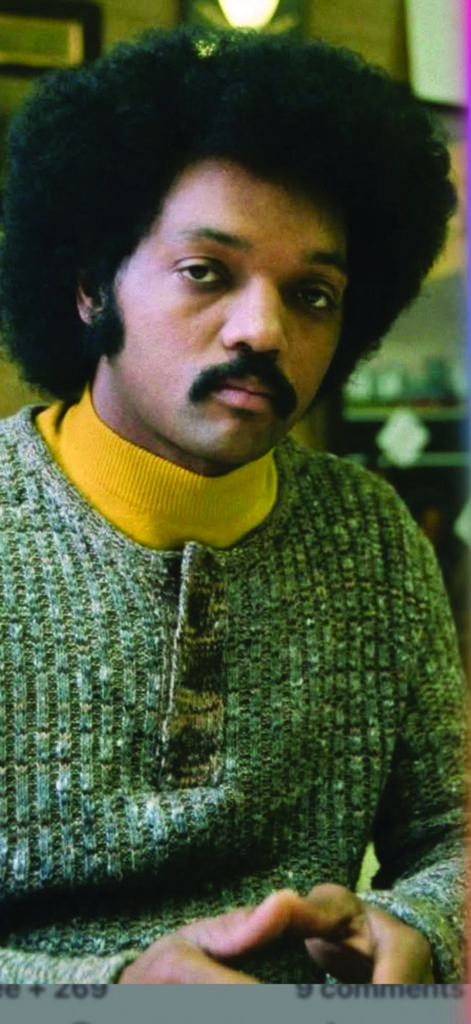
Jackson burst onto the political scene in the early ’60s as a civil rights wunderkind. After graduating from North Carolina A&T University, where he had been a student leader in the sit-in movement and an organizer for the Southern Christian Leadership Conference (SCLC), he moved to Chicago in 1964 to attend Chicago Theological Seminary. Within a year, the Rev. Martin Luther King Jr. tapped him to direct the SCLC’s Operation Breadbasket in Chicago. In 1971, he broke with the SCLC and created Operation PUSH (People United to Serve Humanity), which soon emerged as a leading force in the Black struggle for economic empowerment and educational opportunity. Brash, articulate and mediagenic, Jackson quickly became popular with journalists looking for clever soundbites. His audacity and his Southern Baptist pedigree made him a hit in the Black community as well. By the beginning of the ’80s, Jackson was unrivaled as the country’s pre-eminent civil rights leader. In 1984, Jackson violated protocol by vaulting ahead of established Black politicians and running for president. He received 3.5 million votes during the primaries, and his campaign registered more than a million voters. Really more of a crusade than a campaign, his presidential run—for a brief historical moment—energized the Democratic left. Jackson parlayed that energy into the formation of the National Rainbow Coalition, the Washington, D.C., group that served as a platform for his second run for president in 1988. That year, he won 7 million votes in the Democratic primaries, coming in first or second in 46 out of 54 races.
Thus, many Black reporters got a shot at presidential coverage for the first time. This breakthrough not only diversified the press corps but also highlighted the systemic barriers that had previously excluded Black journalists from such high- profile assignments. Jackson’s campaign became a catalyst for change, inspiring future generations of Black leaders and journalists alike.
Mediagenic and quick-witted, Jackson seldom failed to provide the appropriate soundbite. His ability to deliver sharp, memorable quotes made him a favorite among journalists and helped ensure that his campaign received extensive media attention. This visibility not only amplified his message but also solidified his status as a member of the Black leadership pantheon.
However there is one aspect of Jackson’s political ascendency that often goes remarkably unnoticed, and that is his unprecedented alliance with the Nation of Islam. That break of precedent went both ways; the NOI’s endorsement of Jackson’s presidential campaign was the first time the group has officially joined the electoral fray. Jackson’s embrace of the NOI, which is helmed by the charismatic Louis Farrakhan, was a move that has been underemphasized for its historical significance. Jackson’s alliance bridged many gaps, including one between Muslims and Christians, and one between integrationists and Black nationalists.
To note that Jackson’s ecumenicalism may have been prompted by threats from the Jewish Defense League (JDL), which at the time was chanting things like: “who do you want, Jesse Jackson; how do you want him? … dead,” is not to devalue his efforts. Although, it certainly didn’t hurt to have the FOI as protective escorts during many of his press junkets.
The JDL’s death chants were, in part, a reaction to press leaks that Jackson jokingly referred to New York City as “hymietown” during an “off-the-record” conversation with Milton Coleman, a Black Washington Post reporter. This, of course, lit a fuse in NYC, always attuned to any hint of anti-Jewish sentiment, and Jackson was widely condemned as an anti-Semite in America’s media capital.
Coleman’s absence of journalistic ethics (reporters often conduct “off-the- record” interviews to get at thorny truths that add perspective to the story but remain anonymous) was strongly excoriated in the Black community, though he was promoted by the Post soon thereafter.
Jackson moved from Chicago to Washington in 1989, where he struggled mightily for statehood as the district’s “shadow senator.” But he never seemed comfortable so close to the seat of power.
“Official Washington is an unreal place, and after being there for a while, one begins to feel a little unreal as well,” he says. He returned to Chicago in November 1995 to revitalize Operation PUSH and to refocus his efforts on issues of grass-roots organizing.
In the two years since his return, Jackson has been virtually indefatigable. He combined the National Rainbow Coalition and Operation PUSH into the Rainbow/PUSH Coalition, merging the former’s political focus with the civil rights orientation of the latter. He served a crucial but behind-the-scenes role in the special 1995 election of his son, Jesse Jackson Jr., to Congress from Illinois’ Second District. Last March, Jackson opened a Rainbow/PUSH Coalition branch office on Wall Street. He intends to use it to “monitor corporate racism.” In July, he traveled to Japan to meet with Mitsubishi Motors Corp. executives about employee discrimination. From there, he went to Indonesia, where he toured the low wage manufacturing operations that he insists are pulling jobs away from American workers. He threatened boycotts to persuade Mitsubishi and Texaco (which was embarrassed by the release of audio tapes featuring racist remarks by company officials) to make serious efforts to improve opportunities for minorities. Jackson campaigned in Tennessee for state aid for schools and marched alongside AFL- CIO President John Sweeney at a Watsonville, California rally on behalf of strawberry workers. When University of Texas Law School professor Lino Granglia said in September that Black, and Latino students cannot compete academically with whites because they come from cultures that do not consider failure a disgrace, Jackson helped organize a massive demonstration at the school, where he urged a boycott of Graglia’s classes. He also helped organize an October protest march in California against the anti-affirmative action Proposition 209.
The Clinton appointment will give Jackson an opportunity to do some more globetrotting. “I’ve always wanted to be of service to our country’s” he told a gathering of journalists at the Chicago headquarters of the Rainbow/PUSH Coalition in October. “I want to use my expertise in the area to try and build bridges between the United States and Africa and to expand democracy, human rights and trade development with Africa." He said that it was in the United States’ national interest to increase its trade with Africa, a continent of immense natural resources. “After a century of colonial struggles, it’s now the period of reconstruction for much of the continent,” he said. This inside-outside modus operandi is vintage Jackson. But with the emergence of Jesse Jr. (called “Junior” by friends and foes alike) as an impressive figure in his own right, Jackson Sr. automatically became an “elder statesman.”
Jackson has often said, he’s a “tree shaker not a jelly maker,” and as long as trees need shaking, somebody’s got to do it. Whether he’s driven by ego or principle, Jackson clearly is traveling the progressive road—as a long-distance driver.
Jackson remains as contemporary as racial and economic polarization. He is peerless in his continuing efforts to close the gaps between races and classes in American society. “I think as time goes on, we’ll realize just how precious Jackson is, “says Ron Walters, director and senior scholar at the African American Leadership Project at the University of Maryland. “He is a man who bestrides Black Anglican politics like a colossus and, as the years pass, he still finds new ways of insinuating himself into America’s political culture. “Walters is right.
Historians undoubtedly will refer to this period of Black leadership as the Jacksonian era. No other figure, Black or white, has had as powerful an effect on America’s racial discourse in the last half of the 20th century as this country preacher from Greenville, S.C. And he’s not finished yet.
Note: This article was written 28 years ago. As the author noted, Jackson wasn’t finished. For twenty-eight years he continued to work toward justice and inspire hope in millions. Even when he could no longer walk or talk he remained on the battlefield.
Salim Muwakkil is a senior editor-emeritus of In These Times Magazine and host of “The Salim Muwakkil Show,” which broadcasts weekly on WVON 1690 AM