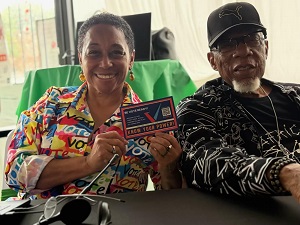



Some people know Reverend Jesse Louis Jackson through history books, through footage of marches and presidential campaigns, through the thunderous cadence of his speeches.
I knew him as someone who prayed for and opened doors for business, the poor and disenfranchised of all backgrounds and colors in a racist city. But let me put this in context: when my dad, a United Auto Workers (UAW) steward and brother were preparing for the 1963 March on Washington, our family prepared the first signs we made for various freedom fights. Shortly after, the Country Preacher was sent to Chicago by SCLC and we were fighting for educational justice. We were engaged in picketing, boycotting and protesting, shouting months later —
“Ben Willis Must Go!”
I attended Breadbasket meetings occasionally with my grandparents, Paul and Izetta Clay, who seldom missed an Operation Breadbasket Saturday Morning Forum. I remember being allowed to take public transportation a few times after school evenings practice for the Breadbasket Youth Choir. And the Black Expos!!!
I grew up in or around those meetings, hearing our family discuss strategies and breakthroughs.
My father opened opportunities here in our South Shore community, extending the Reverend’s boycotts and meeting with men like Al Raby, who later represented him in grievances against city policies restricting Black business opportunities. We picketed the A&P, the dominant food store chain, as did hundreds, eventually opening employment and contractual doors that led to jobs and contracts for Black people at the major department stores, in hotels and in too many industries to name. We made signs at our dining room table and listened to a record by Mary McLeod Bethune called I Leave You Love, that my grandmother brought home from a National NAACP, African Methodist Episcopal Church (AME), or National PTA meeting. By the way, my grandmother’s first cousin was a trailblazer and West Side entrepreneur, Julia Fairfax. Congressman Danny Davis tells her story beautifully.
All that is to say, my grandparents loved the work and results of that Black man known then as The Country Preacher. My spirit hears the Ben Branch band and Cannonball Adderley as I write. I grew up watching a man — an extension of the 1963 March on Washington — sent by SCLC stand in front of a community week after week, year after year, and refuse — absolutely refuse — to let us believe that we were anything less than capable, worthy and powerful. Those Saturday mornings shaped me, and liberation theology became our path forward. I’d often slip in to sit with my son’s father’s parents also now ancestors, knowing that either or both would be in their regular area during the Rainbow PUSH Saturday Morning Forums. What joy!
There’s no wonder we felt compelled to ensure the stories are told and the lived experiences shared, creating this special commemorative issue to honor the Reverend’s life and contributions and his family journey. We wanted to provide a printed keepsake in a time when there is a serious attempt to erase our history. We hope these stories fortify you and encourage you to pull from our AI — that’s Ancestral Intelligence (shared recently by Rev. Dr. Otis Moss III, whose father Rev. Otis Moss, Jr., served on the PUSH board for decades) — to understand that we have individual journeys, failures, and frailties, but ultimately our journey is for others. We proudly present this living document — written by people who were there, who were touched, who were changed.
This issue is a compilation of newly created and previously published articles, the first of which is by my son, Rael Jackson, leading at The Quarry and Real Men Charities. Rael opens with reflections on what it means to carry this legacy forward, and what it has meant to four generations of our family to participate in the life of a man committed to service.
Reverend Jackson’s firstborn son and namesake, Jesse Jackson Jr., offers a sibling’s perspective — intimate and honest. The brilliant Salim Muwakkil gives us the full portrait of the legendary Jesse Louis Jackson. Devorah Crable writes about a new voting bill bearing Reverend Jackson’s name — because his work is still writing itself into law. Darryl Holmes, a U.S. Army retiree, shares how his early start as a youth employed at SCLC’s Operation Breadbasket evolved into military service and how he still shows up today at the Rainbow PUSH Saturday Forum. Taking a page from the Reverend, Holmes invites us to be JesseCrats — people united to serve humanity. David Wallace provides a historical perspective on the origin of Operation Breadbasket. David Wallace, Jesse Jackson, and Gary Massoni came together as students of the Chicago Theological Seminary and emerged as ministers, teachers, and leaders.
Our managing editor, Emma Young, reminds us beautifully that a hero lived right here among us.
And then there are the women, because you cannot tell the story of Jesse Jackson without telling the story of First Lady Jacqueline Jackson — an activist in her own right, a woman of extraordinary grace and iron will who stood for this family and this movement with everything she had. And you cannot tell the story of PUSH without honoring our ancestors and living testaments in action, including Rev. Janette Wilson and the magnificent Betty Magness, whose decades of service (as volunteers, as staff, and as leaders) are a testament to what it looks like to show up quietly and consistently for justice. Rev. Janette was always too busy to sit for an interview, but her work, dedication, and spirit have been the wind beneath our wings.
They say a man is known by his fruit, and the Reverend and his lovely wife blessed the world with six beautiful offspring — Santita, Jesse Jr., Jonathan, Yusef, Jackie, and Ashley — all brilliant, well-qualified, committed, and prepared to carry us forward.
I was exposed to the Reverend and Jackie since I was 10, and worked with Rev. Willie Barrow, Rev. Ed Reddick, and Alice Tregay — now ancestors worth mentioning. I have seen what it costs to dedicate yourself so completely to a people, a cause, and a calling. I have also seen what it gives back — in community, in purpose, and in the young people who sit in Saturday morning meetings and go home different than they came.
It is our promise that the stories of those who built the path toward justice will continue to be told, in their own voices, for generations to come, as we continue to serve as placekeepers of our history and our culture.
Please join us in thanking MacArthur Foundation and the Field Foundation of Illinois for support that allows the South Side Drive Magazine Guide to the Good Life Chicago to amplify Black voices, to build grow and serve as a major Chicago publishing influence. In social media, we are #SouthSideDrive. With gratitude and pride
Yvette Moyo