


How one man’s lifelong commitment to cleanliness is redefining community pride—and possibility—in Chicago’s Black communities.
By the time Sel Dunlap was old enough to understand responsibility, he already understood pride. As a boy, he spent weekends mowing lawns, raking leaves, and planting flowers for his mother and grandmother. In his father’s barbershop, he shined shoes—not because he was told to, but because he liked the way people carried themselves differently once their shoes gleamed. Cleanliness, for Sel, was never about appearances alone. It was about dignity.
That early lesson became a lifelong mission.
Today, Dunlap is one of the most persistent and passionate advocates for environmental cleanliness throughout Chicago as a foundation for stronger families, safer neighborhoods, and healthier children. For more than three decades, he has carried a simple but radical belief into community meetings, cleanup projects, museums, parks, and city halls: where children grow up clean, they grow up stronger.
A Mission Forged in Service
Sel Dunlap’s professional journey reinforced what his childhood had already taught him. His first employer, the South Austin Realty Association, received a grant from the U.S. Department of Housing and Urban Development (HUD), through which he was able to help families by moving them into properties that came across his inventory. His experience with the South Austin Reality Association and HUD deepened his understanding of how physical environments shape opportunity.
Housing alone, he realized, was not enough. Dunlap began organizing community meetings around restoration and revitalization, inviting residents to talk openly about the condition of their neighborhoods. Again and again, he saw the same pattern: neglected spaces bred discouragement, disinvestment, and trauma—especially for children.
“Cleanliness,” he often says, “is preventative medicine.”
One Man, One Block, One Message
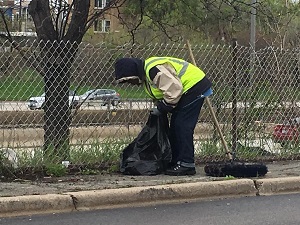
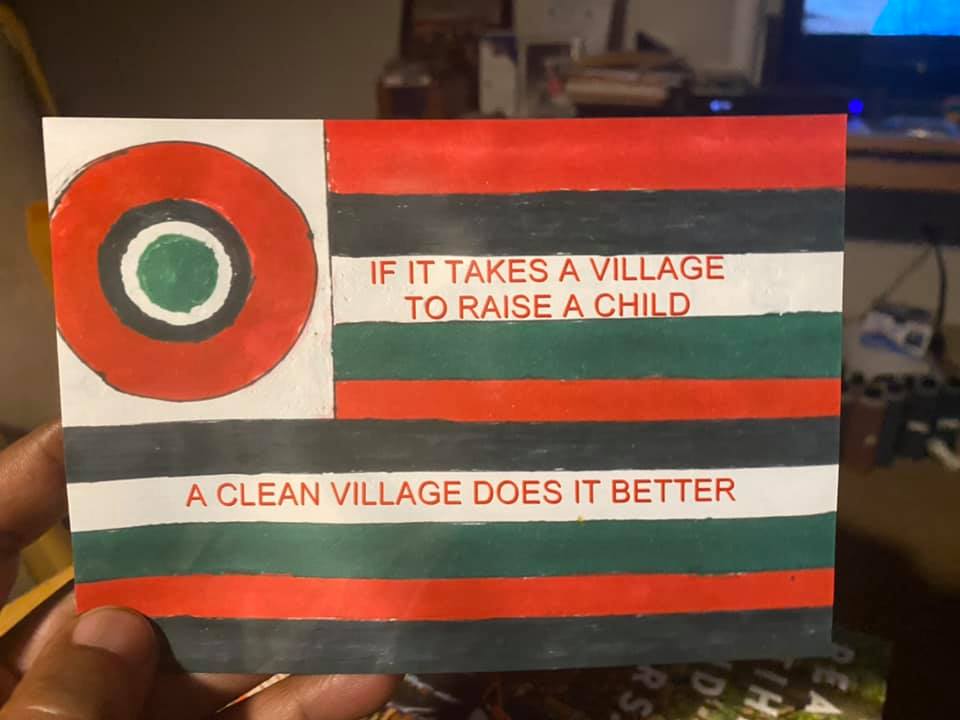
The Gary Indiana Beautification Committee invited Dunlap to participate in a cleanup effort. When the day of the cleanup came, no one showed up but Dunlap, who proceeded to clean up half of a city block by himself. After the cleanup was completed, he painted a sign in bold black letters and planted it where everyone could see:
“If it takes a village to raise a child, a clean village does it better.”
A Tribune reporter photographed the sign, which was featured in the next day’s paper.
That phrase has since become both a motto and a movement.
Dunlap met with the Gary City Council four times after that, which resulted in him engaging in a cleanup project on Broadway. Again, no one showed up to do the work but him.
For Dunlap, the connection between cleanliness and children’s well-being isn’t abstract—it’s backed by research and reinforced by lived experience. Studies from the Centers for Disease Control and Prevention, who did a study along with Kaiser Permanente titled “Adverse Childhood Experiences.” The American Medical Association, University of Pennsylvania and the Ford Foundation have conducted similar studies documenting how environmental stressors—blight, disorder, neglect—can contribute to childhood trauma and long-term psychological harm. Dirty, unsafe surroundings send children a message long before words ever do — you don’t matter.
Dunlap is determined to change that message.
From Earth Day to Every Day
His efforts have never been symbolic. Around Earth Day, Dunlap helped mobilize 75 to 80 volunteers at the DuSable Museum of African American History to clean surrounding areas. He coordinated with the Chicago Park District to ensure trees were pruned and public spaces restored—not just cleaned but cared for.
“These spaces tell stories,” he says. “When we clean them, we rewrite the story.”
That storytelling instinct is central to Dunlap’s approach. He doesn’t just ask people to imagine a better block—he shows them. Using photo editing tools, he creates before-and-after images of storefronts and streets, illustrating how a few flowers, fresh paint, and clean sidewalks can transform not only property values but community morale.
Ebony Zones: A Vision for Holistic Community Health
Now, Dunlap is preparing to launch his most ambitious initiative yet: Ebony Zones, targeting Black communities.
Modeled in part on the internationally recognized Blue Zones Project, Ebony Zones will encourage Black community residents to embrace cleaner streets alongside healthier lifestyles. The program will partner with local organizations to promote environmental stewardship, better nutrition, purpose-driven living, and collective responsibility.
Dunlap is confident in the results. He offers a guarantee that few are bold enough to make:
“Clean up your streets, and property values will rise. Crime will go down. Self- esteem will go up. And people will live longer.”
He plans to back that promise with action—joining cleanup efforts personally, distributing flyers and posters, and recruiting businesses to participate. His goal is not perfection, but participation.
“Awakening people,” he says, “is the real work.”
Teaching Cleanliness to the Next Generation
Perhaps the most enduring part of Dunlap’s legacy lies in education. He has developed a recycling curriculum for kindergarten through eighth grade, rooted in the belief that environmental responsibility must begin early.
He often points to Montgomery County, Maryland, where aggressive school-based recycling programs are credited with long-term environmental success. Dunlap wants to replicate that model locally—teaching children not just how to recycle, but why stewardship matters.
When children see adults caring for their surroundings, he believes they internalize a sense of ownership and self-worth. Clean spaces become classrooms, and streets become lessons in possibility.
A Cleaner Future Starts Now
Sel Dunlap doesn’t wait for permission to do the work. Whether he’s cleaning a block alone, mobilizing dozens of volunteers, or designing programs that link cleanliness to longevity, his message remains consistent: the future is built in the environments we create today.
For the children watching—from porches, school windows, and playgrounds—those environments speak volumes.
And thanks to Sel Dunlap, they’re beginning to say something hopeful.