

The Chicago Urban League was the bastion of civil rights in the 60’s and 70’s. Housed in what is known as the Swift Mansion, under the charismatic leadership of Edwin C “Bill” Berry, the Chicago Urban League (CUL) was responsible for many social reforms in Chicago, such as ridding the Chicago Public Schools of the “Willis wagons,” the trailers in which Black school children were taught under deplorable conditions. The trailers were named for, Benjamin Willis, the racist superintendent of the Chicago Public school who erected them in Black neighborhoods. In the summer of 1966, Bill Berry and a coalition of African American clergy, journalists and organization heads convinced the iconic Civil Rights leader, Reverend Dr. Martin Luther King to come to Chicago to help address the epidemic of racial injustices impacting the lives of Black Chicagoans..
That summer, Berry held cabinet meetings with Dr. King and his entourage and other community activists, every Tuesday at 10:30 am. And at 10:30 am, female employees young and old would come out of their offices to see – not Dr. King, but the good-looking young man Dr. King had brought with him from Alabama. Jesse Jackson, with his big afro, tight jeans and shirt opened to the navel, was aptly described as “fine.” Yet Chicago soon found out there was much more to Jesse Jackson then serving as eye candy to an enthusiastic group of young women.
Having come to Chicago from the recently desegregated South, Jackson soon learned that Jim Crow wasn’t just a southern phenomenon. In fact, after Jim Crow allegedly ended via the Civil Rights Act. its covert cousin, James Crow continued to reside in Chicago businesses and government. Dr. King appointed Jackson to head Operation Breadbasket, which was the economic arm of the Southern Christian Leadership Council (SCLC), and Jesse Jackson meant business.
At that time, supermarkets in the Black neighborhoods openly discriminated in their hiring practices. Except for a few “stock boys” the supermarkets were completely void of African American employees. There were no Black cashiers, no Black butchers (back then, the supermarkets had a butcher’s counter where customers could purchase fresh meat and poultry, cut to their satisfaction). When the stores refused to negotiate hiring agreements, Jackson called for boycotts. Soon Black cashiers and clerks, and Black butchers could be seen in supermarkets, with one exception – Del Farms Supermarket on 63rd Street and Vernon Avenue in the Woodlawn neighborhood closed their stores rather than hire any African Americans. Boycotting became a successful tactic, not only for supermarkets and retail stores, but for businesses throughout Chicago’s South and even the threat of boycotting led to businesses quickly acquiescing to his demands. Some dairy industry companies were targeted, as were Pepsi and Coca-Cola bottlers. It was during this time that he organized weekly Saturday meetings, which continued when he became independent of SCLC and changed the name to Operation PUSH, People Organized to Serve Humanity.
As an employee of the Chicago Urban League during that time, I got to see Jesse Jackson close and upfront, but I never got to meet or interact with him personally. I did meet his wife, Jacqueline at a Chicago Urban League Golden Fellowship Dinner. We met in the Ladies Room and hit it off immediately . At that time she had one child, Santita, but she told me she wanted to have five children. She accomplished that with Santita, Jesse Jr., Jonathan, Yusef, and “Little Jackie.:
Barbara Proctor was a talented young woman who wanted to start her own agency. At that time, Black-owned advertising agencies were extremely rare. In fact, there was only one to my knowledge and that was Vince Cullers Advertising.
Jesse Jackson had a friend at Sears by the name of George O’Hare. I wrote George O’Hare’s memoir, “Confessions of a Recovering Racist,” in which he recounts his friendship with Dr. King and Jesse Jackson. Jackson called upon a friend, Bob Law, who owned a general market advertising agency, to help Barbara Proctor create a campaign to present to Sears. Thus was the beginning of Proctor and Gardner Advertising Agency, with Sears, Roebuck as her first client.
It was also around this time that Jesse Jackson created PUSH-Excel, the education arm of Operation PUSH. Its purpose was to motivate Black students, emphasizing how parents should make sure students were in school on time and did their homework. At that time I had begun my career at Leo Burnett Advertising and Jesse Jackson came to Leo Burnett to create a campaign for PUSH-/Excel. Carol Williams (currently CEO of Carol H. Williams Advertising) was at the time my Associate Creative Director, and she and I were the only Black females in Leo Burnett’s creative department. Thus, the assignment came to us and that’s how I really met Jesse Jackson.
I left Burnett in 1980 to join Soft Sheen Products. At that time, Jesse Jackson, who had become Reverend Jesse Jackson, had launched a voter registration campaign with phone banks urging people to register. Once again Reverend Jackson’s and my paths crossed as I was working on the voter registration campaign through advertising that was blitzing the city with the slogan “Come Alive October 5.” Reverend Jackson even hosted Soft Sheen’s President Ed Gardner and me in his backyard to discuss how we could work together on the campaign.
After Harold Washington’s election, Tom Burrell recruited me to work at his agency. I gave Soft Sheen two weeks’ notice and was looking forward to beginning work at Burrell, when Frank Watkins, Reverend Jackson’s political advisor, invited me to a meeting with him at PUSH. Frank took me through the PUSH building, telling me the history and mentioning Rev. Jackson’s various accomplishments. As we wound down the meeting, he said “Reverend Jackson is going to run for president.” “Of the United States?” I asked. “Yes,” he replied, “Of the United States.” Although I created the “Come Alive October 5” slogan, and helped Congressman Washington write his announcement speech, and wrote advertising for Washington’s campaign, and was loaned to the campaign office in the final days of the general election, I did not consider myself a political person. Citing the fact that I was going to be starting a new job at Burrell, I declined. Looking back, I could have been what Donna Brazille became in the political world.
When I was at Burrell, Reverend Jackson came to Burrell for an advertising campaign for Operation PUSH. I was given the assignment, and I met with Rev. Jackson and Reverend Janette Wilson. Shortly after that, Rev. Wilson invited me to speak at a forum that PUSH was holding with Chicago gang members.
The next time I saw Reverend Jackson was when I began working for RJDale. His first statement when he saw me was “I see you everywhere!” Rev. Jackson was instrumental in getting RJDale an invitation to compete for the Toyota account, although we lost to Burrell, we came very close.
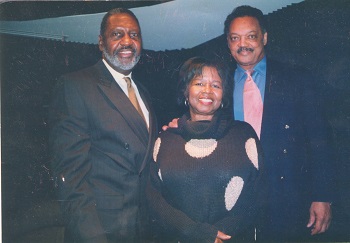
In 2000, Carol Williams, whose agency was anchored in California, opened an office in Chicago, and hired me. When we had a meeting in California, guess who I ran into again? Reverend Jackson. And again at a Harold Washington Legacy Committee luncheon at Roosevelt University.
Reverend Jackson has been a gift to Chicago, that kept on giving, even after he retired and passed the torch to his son, Yusef Jackson. Happy Birthday, Reverend.