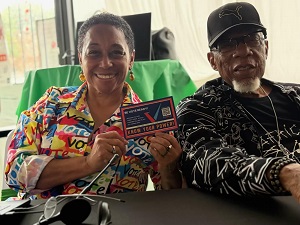



No warning! No symptoms. I was feeling fine the day I went for a regular exam and I heard those dreaded words from my doctor: “you have prostate cancer.” That was more than twenty-two years ago.
As a single father with two daughters, at that moment, I had to come face-to-face with my mortality. The doctor told me I was lucky to be diagnosed so early, because the cancer had not spread. I was lucky to even be diagnosed at all. You see, until 2003, I had never been screened for prostate cancer. It wasn’t until my close friend; Les Brown persuaded me to take a simple blood test which can indicate the presence of the disease. It’s called the PSA test (Prostate-specific-antigen), which is a blood test that measures the amount of a protein produced by the prostate gland. It’s painless, but it’s a life-saving test. I know it saved mine. I was drowning and did not know it and Les was my lifeguard. He gave me a life preserver in the form of information. Now, I’ve made it my mission to inform every male I can about the test/ Previously I would refer them to Dr. Terry Mason, he is now retired, but his advice still resonates.
For years, Dr. Mason advocated for men to take the PSA test, and many lives were saved among those who followed his advice. Dr. Mason, a retired Chicago-based urologist and public health leader, served as the Commissioner of the Chicago Department of Health and later as Chief Operating Officer/Chief Medical Officer at Cook County Department of Public Health. According to Dr. Mason, ninety percent of people with prostrate cancer feel nothing – they have no symptoms, which is why he always would say, “Don’t guess, get the test.”
The facts are alarming. African American men have a 67 percent higher incidence rate of prostate cancer compared to white men, and are more than twice as likely to die from the disease. One in six Black men will be diagnosed with prostate cancer in their lifetime, compared to one in eight white men, and from 2014 to 2018, African American men were diagnosed with prostate cancer 73% more often than
white men.
Studies suggest that African American men may have distinct genetic mutations associated with more aggressive prostate cancer, underscoring the need for race-specific research and therapies.
According to Cancer.gov, socioeconomic and environmental influences, such as living in disadvantaged neighborhoods, could contribute to the increased likelihood of African American men contracting the disease.

The right diet can lower your chances of ever encountering the disease. In 2019, Dr. Mason was interviewed at the Veggie Fest where he was asked about what he would advise men to begin doing right now besides taking the test. He said, “A plant-based diet plays into the prevention of disease. There are studies now that show that when you drip the serum (derived from blood) from a plant-based eater onto prostate cancer cells, it helps kill those cells at a rate of about 79% as opposed to the blood from a meat eater that kills only about 9% of those cells. There are more and more significant medical studies like this one coming out every year.”
When asked what foods he suggests, he said, “I tell my clients to just add more vegetables, and add a bit more each week until their plate is crowded with fresh, delicious vegetables. I have them watch “Forks Over Knives” (available on YouTube), and I have them talk to other people who have made this transition. I want people to understand that this is not a boring diet. It is the most natural and is age-old. This diet has been with us as long as we have been on the planet. I tell people that if a meat-based diet is so good for us, then why do we spend more money than any other country on the planet, and yet our health outcomes are worse than those where they spend less?”
Dr. Mason also says, “Prostate cancer is very curable and very survivable, and the earlier one gets tested, the better the outcome.”
Ranoule’ Tatum. known to many as "The Motivators Motivator" is one of the nation’s premiere professional speakers, talk show hosts, Inforprenuers, influencers, personal development coaches, and trainers.